“Yet You Dumbf—s Want to Shut Down the Mall Ride”: Three Times I’ve Watched Public Pressure Push RTD
3 Examples I've Seen Lately Where Public Pushback Can Change The Conversation Around RTD.
I've lived in Colorado for a year now, and I've lived car-free the entire time. I rely heavily on RTD.
I'm a passionate user of the system, but I'm also starting to become one of its critics.
Over the past several months, I have started watching agency debates closely and have noticed that public pressure can matter.
It does not always produce an immediate victory, and it is rarely possible to credit one person, post, article or meeting for an agency’s decision.
But organized riders and broader public pushback can force decision-makers to explain themselves and reconsider assumptions.
I saw it with Route 228 in Superior. I saw it after reporting that Denver’s 16th Street FreeRide was placed on a list of possible cuts. And I saw it when Longmont residents learned that RTD could finally create a direct airport bus.
1. An RTD Board Candidate’s Crusade to Save an Hourly Suburban Bus
I met Jack Rosenthal for coffee in Longmont while he was trying to save Route 228.
The route connects Superior, Louisville and Lafayette with Flatiron Crossing and regional transit connections along U.S. 36. When RTD proposed discontinuing it, the agency’s analysis described a poorly performing route averaging four boardings an hour at a cost of $33.31 per boarding.
Jack approached the issue differently.
He created SaveThe228.com, printed signs and taped them to stops so riders would know the route was in danger. Jack told Denver7 that riders facing the loss of Route 228 had three options: buy a car, get a bicycle or move somewhere else.
That campaign helped reveal the people concealed behind the spreadsheet. The RTD board received dozens of public comments ahead of its meeting later this month, when it will decide on the final September service changes.
One commenter told RTD that her son, who has an intellectual or developmental disability and cannot drive, walks a mile to Route 228 to reach his job. Another said the route was a disabled friend’s connection to physical therapy, sports classes and social life. A 90-year-old rider wrote that without the bus she would be stranded and unable to reach the doctor’s office where she receives infusions.
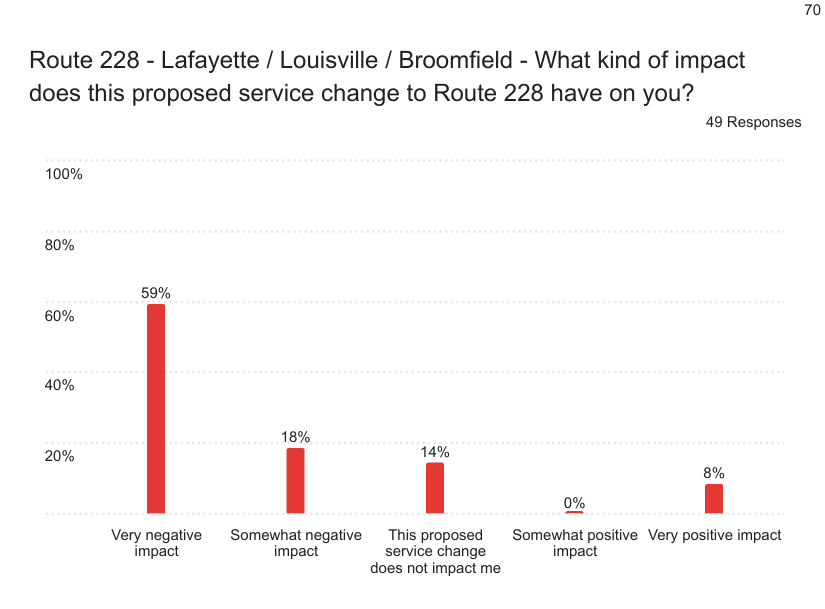
Other riders explained that Route 228 is their first-mile connection to the Flatiron Flyer, airport service, groceries and employment. One resident said the route allowed her family to remain a one-car household. Another said eliminating it would turn a manageable trip to pick up groceries and mail into a one-way journey of an hour or more.
Jack told me in an interview Monday that just because Route 228 survives the September service changes does not mean it will be spared the next time RTD reviews service. The immediate fight may have bought the route more time, but it did not eliminate the underlying questions about its ridership, cost and long-term future.
2. The 16th Street Story Reached the Mayor’s Office
The second example moved much faster.
While reading RTD’s 444-page packet for the July 15 Operations Committee meeting, I found that the agency’s service-reduction models placed the 16th Street FreeRide on the chopping block in four of five cut scenarios.
The route recorded about 2.3 million boardings in 2025 and cost approximately $3.17 per boarding, but staff classified it as duplicative and estimated that eliminating it would save nearly $9.5 million annually.
I published the finding last weekend and watched media outlets across the Front Range begin covering it hours later.
Denver City Councilwoman Flor Alvidrez shared my work, and so did Jack. Their posts helped move the proposed shuttle cut from an obscure line in an RTD packet into a wider public debate about whether eliminating a heavily used free service made sense.
In our conversations, Jack also described the 16th Street FreeRide as a “gateway bus”—a low-commitment introduction to Denver’s transit system for tourists and casual riders who may not otherwise feel comfortable navigating RTD.
The route asks almost nothing of a first-time passenger: no fare, no complicated transfer and no major planning. Riders can simply get on, move between major downtown destinations and become more familiar with using public transportation.
The reaction was immediate because the proposal seemed to conflict with what Denver had spent years trying to accomplish. The city had recently completed a $175 million reconstruction of 16th Street.
The anger eventually reached Mayor Mike Johnston’s office.
“We are deeply sympathetic to RTD’s budget situation, but cutting a popular service used hundreds of thousands of times a month and millions of times a year isn’t the answer,” spokesperson Jon Ewing told Denverite.
Ewing added that the FreeRide supports downtown, connects Civic Center and Union stations at no cost and represents the kind of service needed to persuade more people to use transit.
The Downtown Denver Partnership also joined the pushback. Its CEO told RTD directors that boardings had nearly doubled to more than 250,000 since construction ended and warned that eliminating the shuttle would undermine a recovery success just as it was gaining momentum.
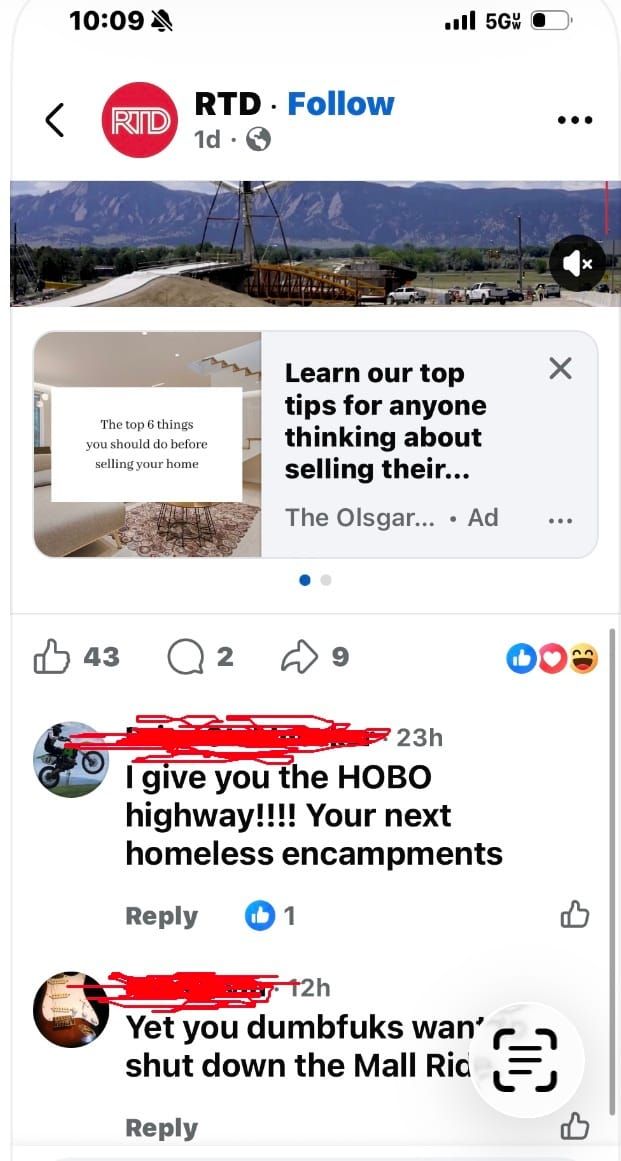
The anger spread beyond stories and posts specifically about the FreeRide. Under an unrelated RTD Facebook update about the CO 119 project between Boulder and Longmont, I opened the hidden comments and found this: “Yet you dumbfuks want to shut down the Mall Ride.”
RTD has not formally selected the routes that would be eliminated under its recommended budget target. One committee recommended planning around a 10% reduction, but directors emphasized that the route list was illustrative and that specific cuts would undergo further public review.
So this is not yet a story about the public saving the shuttle.
It is a story about reporting and public pressure preventing a consequential proposal from remaining buried in a spreadsheet. Once people understood the implications, RTD could no longer treat the FreeRide as merely a line item worth $9.5 million.
RTD Director Matt Larsen wrote to Thompson's Colorado and provided the following statement on the scenarios:
"Staff provided scenarios in the OSS and Finance and Planning packets to illustrate what different levels of cuts could look like in terms of specific lines. The lines shown were based on our established guidelines on service efficiency. However, the discussions in committees were not (and were never intended to be) about the merits of specific service reduction packages, only on the total level of cuts to recommend to the full board. Whatever level of cuts is ultimately decided on, they wouldn’t be effective until the middle of next year, and we will go through additional work to identify how to do those probably up until January or February of next year. And zero cuts is still an option (and one that I am pushing)."
3. Longmont Showed RTD the Demand for Route AL
The third case involved building service rather than protecting it.
RTD has proposed Route AL, an hourly bus operating daily from Eighth Avenue and Coffman Street in Longmont through Niwot and Lafayette to Denver International Airport. The proposal was developed in response to requests from policymakers and stakeholders and supported with grant funding.
When I posted an Instagram reel explaining the proposal, it received roughly 15,000 views.
People began asking when the first bus would leave, whether the schedule would serve 6 a.m. flights, where they could park and how late the final return trip would operate.
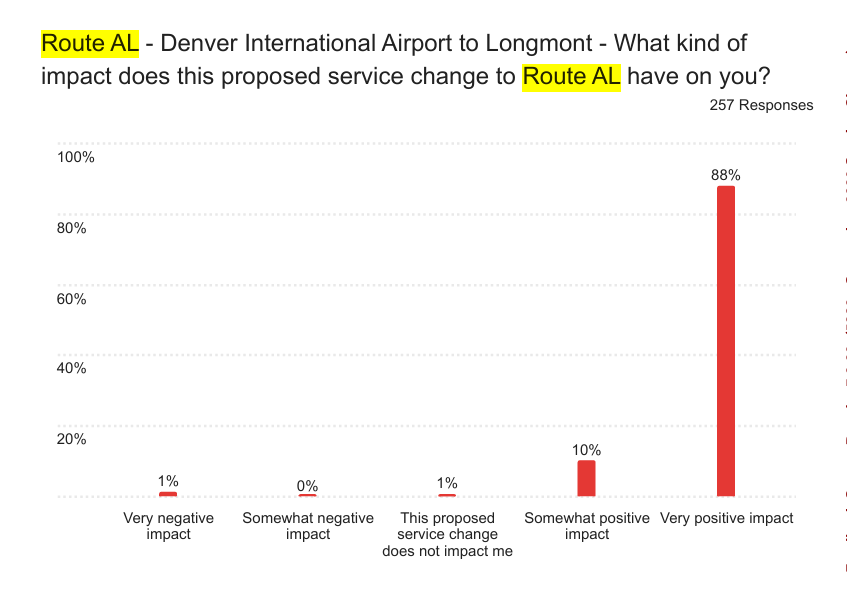
The comments submitted directly to RTD reflected the same demand. One Longmont resident said a Lyft to the airport costs about $100 and described a scheduled ride that failed to arrive on time. The resident called the proposed bus a potential “game-changer.”
Another commenter said reaching the airport by existing transit can take more than four hours, while Longmont-area travelers routinely spend $75 to $200 on rides, parking or private transportation. Several residents asked RTD to begin service around 4 a.m. to accommodate early departures and extend return service later for evening arrivals.
Others said they had never used RTD but would use this route. One longtime Boulder County resident wrote that expensive rideshares, traffic and pollution had kept transit from being practical, but the proposed airport connection would change that.
The route was already in development before my reel. I cannot claim that a video created it or single-handedly persuaded RTD to proceed.
But the response supplied something valuable: visible evidence that the demand was real. It showed that Longmont’s frustration was not limited to transit advocates or elected officials. Residents were ready to describe exactly how they would use the service and what kind of schedule would make it useful.
That is the common thread across all three cases.
Jack’s signs transformed Route 228 from a low-ridership number into a question about independence and access. Reporting on the 16th Street FreeRide brought a buried budget concept into the mayor’s office and the center of Denver’s downtown debate. The Route AL reel gave Longmont residents a way to demonstrate that an airport bus would attract more than theoretical support.
Public pressure does not control RTD, but I think there is ample evidence that riders and elected officials can push the agency to reconsider decisions or respond to demand.