What the Hell Is a Metro District? One in Five Coloradans Lives in One
These miniature governments expect to collect $1.2 billion in property taxes across the state this year. Longmont considered expanding their use for residential development—and City Council rejected the idea.

One in five Coloradans lives inside a layer of government many residents don't find out about until looking at their property tax bill, sometimes years after purchasing their homes.
This mini government can borrow money, build roads and utilities, levy additional property taxes and remain in place for decades. It may be created before its future residents have arrived, with financing decisions made by a board associated with the developer whose project it helps build.
It is called a metropolitan district.
Colorado has more than 2,500 of them. Eight days after the state auditor released a sweeping report warning that oversight has failed to keep pace with their growth, Longmont considered whether to expand their use for more residential development at its Oct. 27 meeting.
The meeting addressed two development sites in Longmont: the Sugar Mill and a proposed mixed-use development north of Highway 66 called Beauprez Farms.
Developers for those projects said metropolitan districts could make those infrastructure improvements possible.
So what the hell is a metro district—and who ends up paying?
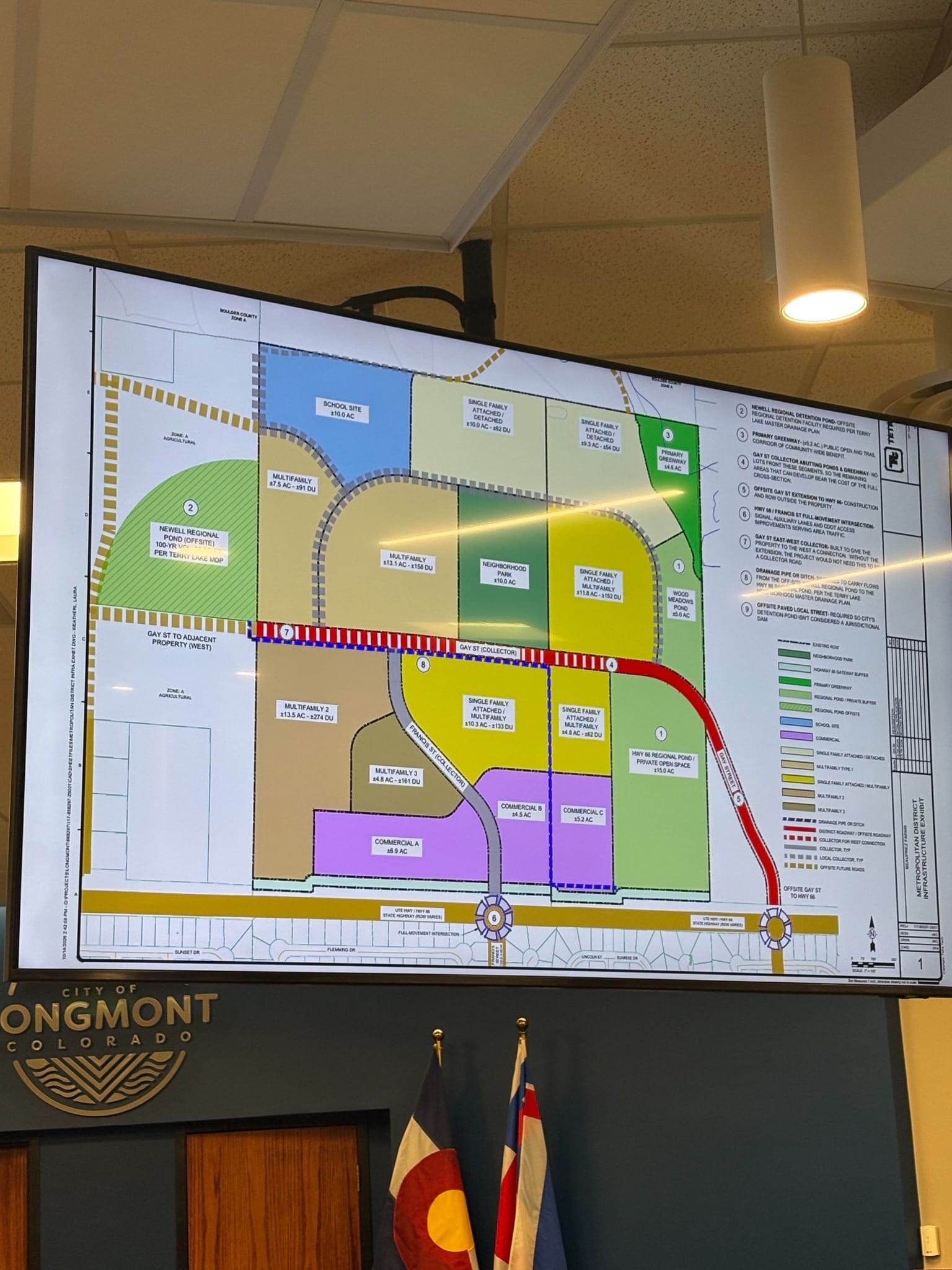
The Beauprez Farms concept includes housing, commercial parcels, a school site, parks, regional drainage facilities and new road connections near Highway 66 in northwest Longmont. Developers say the project's large upfront infrastructure costs make it financially infeasible without special financing. Photo: Nicholas Thompson
I. One in Five Coloradans Lives in One
Metro districts sound like an obscure concern for municipal attorneys and real-estate developers. They are anything but obscure.
Colorado had 2,509 metro districts as of October 2025, according to a performance audit released by the Colorado Office of the State Auditor on Oct. 19.
An estimated 1.2 million people—about 20 percent of Colorado's population—live in metro districts. They contain approximately 572,000 homes and expect to collect about $1.2 billion in property taxes during 2026.
That's partly why Longmont councilmembers were skeptical of expanding them. It's in the fine print, but who actually reads it?
II. What Does a Metro District Actually Do?
A metro district is a small local government created around a defined piece of land. It can finance and provide at least two public improvements or services, such as streets, water, sanitation, parks, transportation or fire protection.
Here is the ten-year-old version:
- A developer wants to build homes or businesses.
- The project needs expensive infrastructure before most of that development can occur.
- The metro district borrows money by issuing bonds.
- Roads, drainage systems, utilities, parks and other public improvements get built.
- Property owners inside the district repay that debt through additional property taxes and sometimes fees over many years.
For my readers familiar with Missouri, it is roughly the same family of tool as a Community Improvement District (CID) or Transportation Development District (TDD) —but broader. A Colorado metro district can combine multiple functions, carry long-term debt and continue operating as a miniature government after construction ends.
The theory makes sense. New development requires public infrastructure, and somebody has to pay for it.
Look at Longmont's Sugar Mill. Its crumbling brick buildings and silos come with potential environmental cleanup and major infrastructure needs before the property can support new development. City staff said tax-increment financing alone would probably not cover all the necessary public improvements. Making that site usable could take an enormous amount of work before a developer has anything to sell.
A metro district directs those costs toward the properties that benefit instead of every taxpayer in the city.
It also spreads the cost across the useful life of the infrastructure instead of requiring a developer to pay for everything upfront.
The complication is timing and control. A district can be organized before residents live there. Developer-associated property owners may be the only eligible voters, and developer-associated directors may control the initial board. Those directors can make financing decisions that future residents inherit.
The developer builds and sells. The homeowners arrive later and spend decades paying the debt.
III. Why Colorado's Auditor Says the System Is Problematic
Eight days before Longmont's discussion, Colorado's state auditor released a 154-page examination of metro-district governance and oversight.
It did not conclude that every metro district is corrupt or financially unsound. It did find that the state's accountability systems have not kept pace with the districts' explosive growth.
The audit warned that homeowners can face unanticipated tax increases when assumptions about population growth or rising property values fail to materialize. It also identified a “moral hazard” when district boards are led by people associated with a developer.
Developer-associated directors may be motivated to issue debt in a way that helps construction proceed, allows properties to be sold and reduces the developer's risk, auditors wrote. That incentive can conflict with the district's long-term interest after residents move in and become responsible for repayment.
The audit found widespread governance and transparency problems:
- The state's public database lacked a service plan or equivalent foundational document for 855 metro districts—34 percent of the total.
- At least 724 districts—29 percent of those reviewed after the May 2025 election—either failed to properly elect or appoint at least one director or failed to properly file the director's oath and bond.
- In a small survey of 27 local governments that approve metro districts, 85 percent had not requested—or did not know whether they had requested—a five-year oversight report from any district during the previous five years.
- The state office responsible for assisting and monitoring local governments grew from six positions in 2006 to 7.15 available positions in 2025, even as the number of metro districts increased by approximately 150 percent.
The audit recommended better guidance for local governments evaluating whether homeowners could face excessive taxes, stronger filing enforcement, improved access to service plans, fuller district boards and greater scrutiny of debt issuance.
Those findings matter because the safeguards offered in defense of metro districts generally depend upon someone actively enforcing them.
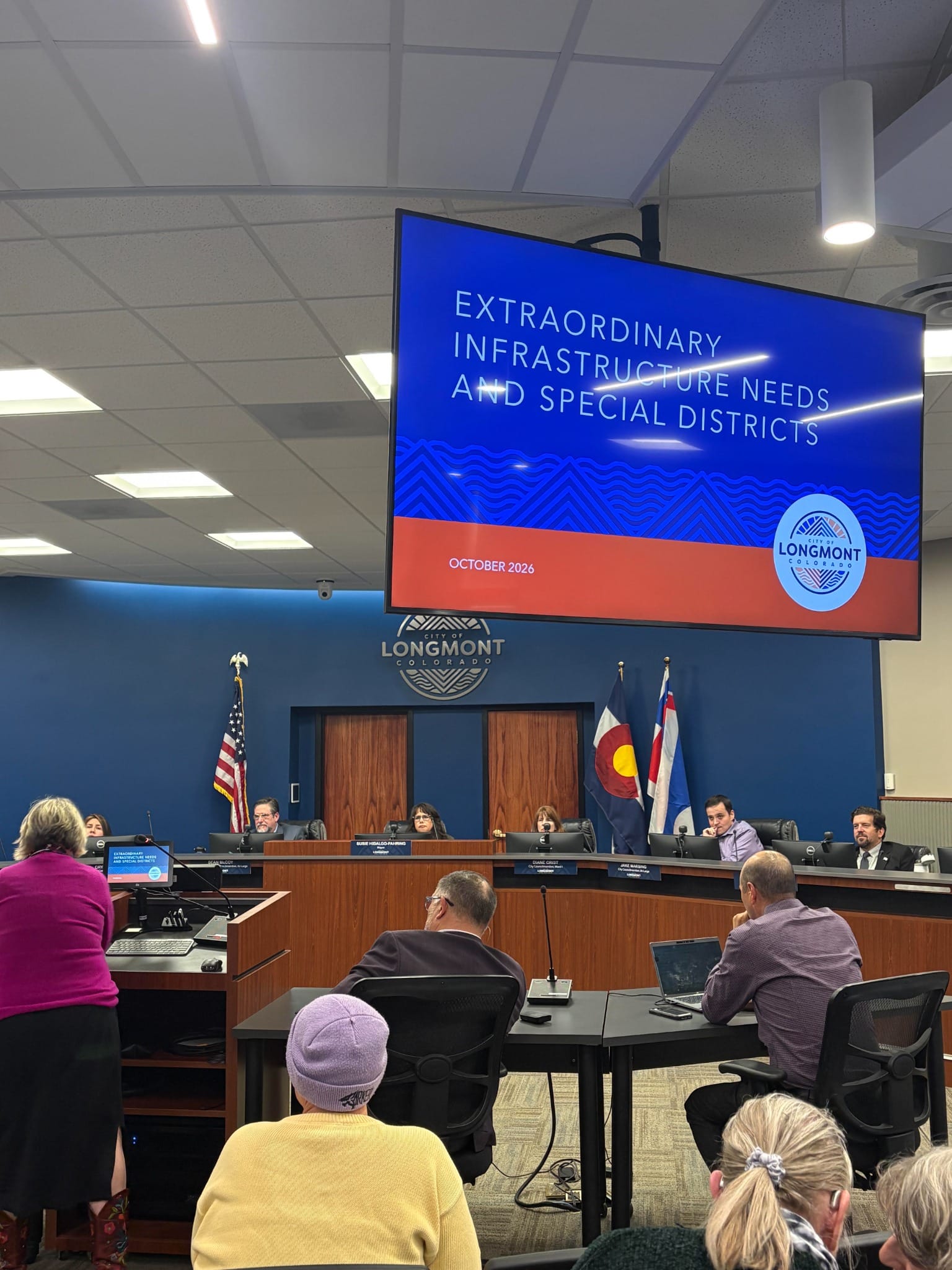
Longmont City Council discusses whether to expand the use of metropolitan districts for residential or more heavily residential mixed-use projects on Oct. 27, 2026. Councilmembers rejected that expansion while leaving other financing tools available. Photo: Nicholas Thompson/Thompson's Colorado
IV. Why Longmont's Code Basically Says No to Residential Metro Districts
Longmont did not need the new state audit to recognize the risks.
The city has generally reserved metro districts in its code for commercial development. It does not allow a district created solely to support residential development. A mixed-use project can qualify only when no more than 50 percent is residential, and the necessary infrastructure or added amenities must be extraordinary or otherwise prevent or limit construction.
The city's explanation for restricting residential districts is unusually plain.
First, it says a residential district can create different property-tax burdens among otherwise similar neighborhoods. Residents inside the district may pay significantly more without receiving a proportional public benefit.
Second, buyers may not understand the higher taxes attached to their new homes. They can be surprised to discover that the sale price did not include streets and utilities—and that those improvements must instead be repaid through property taxes for 30 years or longer.
Longmont does impose safeguards on the metro districts it permits. The city caps their debt mill levy at 50 mills. Debt must be repaid within 40 years. The levy ends when the bonds are paid unless council approves its continued use for maintenance. Each district requires a service plan approved by council.
But Tuesday's discussion revealed little appetite for testing whether those protections would be enough for residential neighborhoods.
V. Why Longmont Studied Them Anyway
Longmont is becoming a more mature, built-out community. Much of its easiest land has already been developed. The properties that remain can carry expensive infrastructure, access, environmental and flood-control problems.
City staff therefore asked whether council would consider a limited expansion of metro districts for residential or more heavily residential mixed-use projects with extraordinary infrastructure or remediation needs.
Here's why Beauprez Farms and the Sugar Mill drove that discussion:
Beauprez Farms
The proposed Beauprez Farms development encompasses approximately 155.6 acres near Highway 66. Its concept plan includes several forms of housing, commercial property, a ten-acre school site, a ten-acre neighborhood park, greenways and regional drainage facilities.
The developers say approximately 44.6 acres—nearly 29 percent of the site—would be devoted to schools, parks, open space or regional drainage instead of revenue-producing development.
They also argue that the project would build infrastructure benefiting a larger area: regional stormwater ponds, improvements at Highway 66, Gay and Francis streets, a future east-west collector, trails, open space and oversized water and sewer infrastructure for future growth.
“Without Metropolitan District financing, development of Beauprez Farms is not financially feasible,” the developers wrote in material submitted to council.
That assertion produced the night's fundamental disagreement.
The developers view the district as a way to assign extraordinary regional costs to property that benefits from them. Skeptics see a developer asking future homeowners to make an otherwise infeasible project pencil.
The unresolved factual question is not whether the improvements are expensive. It is which costs truly serve the broader Longmont community—and which are normal expenses required to unlock a valuable development site.
The former Sugar Factory
The former Great Western Sugar Factory presents a more sympathetic argument for extraordinary financing.
Redeveloping the iconic but deteriorated industrial property could require environmental remediation, major infrastructure and coordination across multiple parcels. City staff said tax-increment financing alone would probably not cover all necessary public improvements.
The Sugar Factory demonstrates why Longmont studied an exception. Some properties may be so difficult that conventional development financing cannot reclaim them.
It also demonstrates the danger of changing citywide policy around the most extraordinary example available. Once the city creates an exception, every future developer has an incentive to describe its roads, drainage or utilities as extraordinary.
“If a developer can't get their project to pencil, they shouldn't develop it," said Councilman Jake Marsing.
Marsing made that distinction during the discussion: Longmont can address an exceptional property without broadly opening residential development to metro districts.
VI. Council's Answer: Keep Other Tools, Reject Metro Districts
No formal vote occurred during the study session, but councilmembers opposed expanding residential metro districts.
Councilmembers did not deny that Beauprez Farms, the Sugar Factory and other difficult properties may require creative financing. They rejected the proposal to make residential metro districts part of that solution.
Marsing and Mayor Susie Hidalgo-Fahring pointed toward general improvement districts, or GIDs, as one possible alternative.
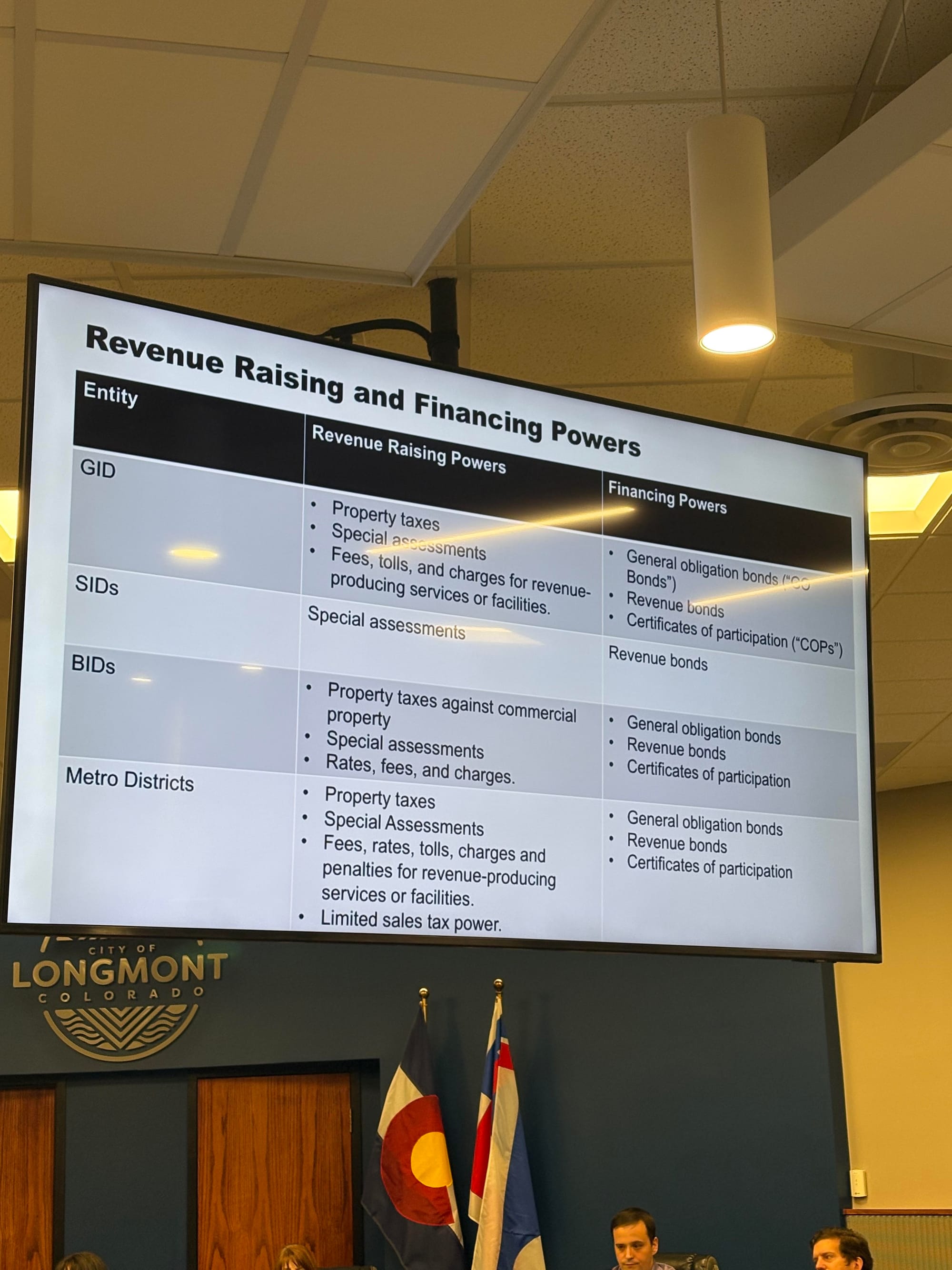
A GID can also levy taxes within a defined area and borrow for public improvements. The critical governance difference is that it remains much more closely connected to the city, with City Council serving as its governing board rather than an independent district board initially associated with a developer.
That gives elected city officials more direct responsibility for financing and tax decisions. It can also affect the city's borrowing capacity and financial flexibility, so it is not free money or an automatic solution.
Near the end of the discussion, City Manager Harold Dominguez asked council whether GIDs and other options could remain in the city's toolkit. Councilmembers agreed.
Their consensus was not “do nothing” and not “never assist development.” It was more specific: solve extraordinary infrastructure and remediation problems through other mechanisms, but do not weaken Longmont's existing protection against residential metro districts.
That leaves the city with harder, project-specific work ahead. It must determine which Beauprez improvements genuinely provide regional benefits, how the Sugar Factory could be remediated, what each project can finance privately and whether a city-controlled tool can responsibly close the remaining gap.
But on the question staff brought Tuesday night, council's answer was clear.
Longmont is willing to keep looking for ways to make its most difficult properties work. It is not willing to create new miniature governments and hand future homeowners decades of additional taxes simply because a development otherwise cannot pencil.