I Read RTD's 444-Page Service Cut Analysis So You Don't Have To
RTD has to close a $200 million budget shortfall, and is looking at service cuts. I break down 12 trends you can see as the slashing begins.
Why Are We Talking About This?
RTD’s Board of Directors is beginning a public discussion about how to address the agency’s long-term financial challenges, as the agency faces a more than $200 million annual budget deficit. Planners are starting to look at reducing routes and eliminating routes entirely to address the shortfall.
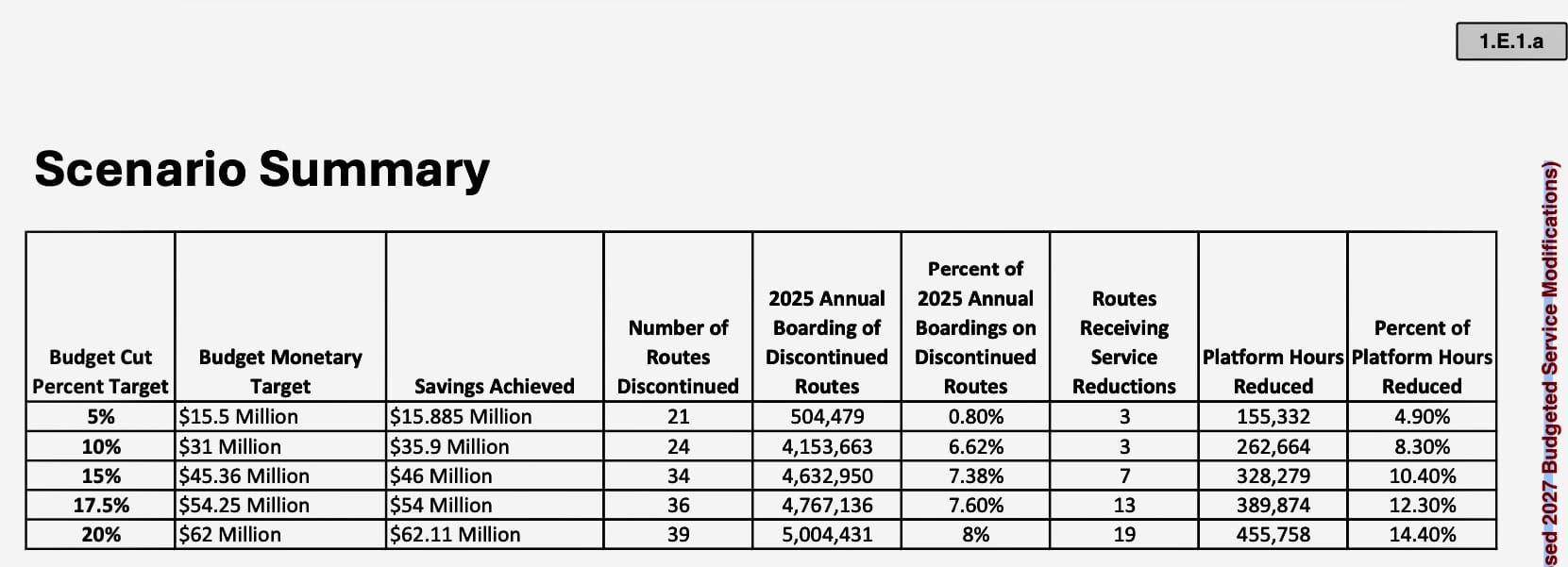
On Wednesday July 15, board members will review a 444-page service analysis that examines what the transit system could look like under a variety of scenarios, including service reductions of 5%, 10%, 15%, and 20%. No service cuts have been approved, and many of the proposals may never be implemented. But the packet offers a rare look at how RTD evaluates routes, weighs tradeoffs, and thinks about the future of transit in the Denver region.
What RTD’s Numbers Seem to Say
Before diving into the findings, one pattern stands out.
RTD doesn’t appear to have a formal cost-per-rider cutoff, but routes costing less than about $10 per boarding generally look safe, while routes costing more than about $40 per boarding appear much more vulnerable.
For example, the SKIP in Boulder costs $5.16 per boarding and survives every scenario, while the LX in Longmont costs $50.15 per boarding and appears in every elimination scenario.
Of course, ridership, geography, equity, and political considerations also matter. But throughout the packet, RTD repeatedly returns to a simple question:
How many riders are being served for every dollar spent?
12 Key Findings from RTD’s Route Analysis
1. Low-Performing Services Face the Greatest Risk
Example: LX in Longmont
The Longmont-to-Denver LX carried just 4,710 riders in 2025 at a cost of $50.15 per boarding and appears in every budget reduction scenario. Unlike all-day local routes, the LX primarily operates during rush hour periods, serving a relatively narrow commuter market. RTD is increasingly willing to consider reductions to services that consume significant resources while serving relatively few riders.
2. Even Rail Isn’t Safe
Example: B Line From Union Station To Westminster
The potential elimination of B Line service to Westminster is one of the most surprising proposals in the entire analysis. For years, communities along the Northwest Rail corridor have debated extending rail service farther north toward Boulder and Longmont. Now RTD is discussing a scenario where the existing B Line service could disappear entirely.
Whether or not that happens, the fact that RTD is even considering the idea underscores the severity of its financial challenges and the extent to which previously untouchable services are being reevaluated.
3. Airport Access Is a Strategic Priority
Example: A Line from Union Station To DIA
The A Line carried more than 6.1 million riders in 2025 and receives service increases in every scenario examined. RTD appears committed to maintaining and growing airport access.
4. RTD Still Sees Opportunities for Growth
Example: Route AL from Longmont to DIA
While much of the discussion focuses on cuts, RTD is also proposing new service and targeted expansions across the region. Route AL would create a direct Longmont-to-DIA connection, one of several proposals aimed at improving access and connectivity.
CLICK HERE for my reporting on Route AL.
RTD may be preparing for difficult tradeoffs, but the agency is not operating in a purely defensive mode. The packet makes clear that RTD still sees opportunities to grow where it believes demand exists.
5. Longmont Is Both a Winner and a Loser
Example: AL vs. LD/LX from Longmont to Union Station
Longmont could gain a direct airport route while simultaneously seeing its traditional commuter routes face potential elimination. The LD currently provides rush-hour regional service between Longmont and Denver, while the LX focuses on peak-hour commuter trips. Both could be on the chopping block while Longmont somehow gains its own airport bus.
Few communities better illustrate RTD’s competing priorities.
6. Even Some High-Performing Routes Could Be Cut
Example: R Line Through Aurora/East Metro
Most people assume transit agencies start by cutting their worst-performing routes. And in many cases, RTD’s proposals do target services with low ridership or high operating costs.
But the inclusion of the R Line shows the situation may be more complicated. The R Line carried more than 1.1 million riders in 2025, making it one of the more heavily used services in the RTD system. Yet it still appears in some reduction scenarios.
That matters because it suggests RTD’s budget challenges may eventually extend beyond eliminating underperforming routes. If the agency needs to save enough money, even routes with strong ridership could end up on the table.
For riders, that’s a significant shift. The question is no longer just whether RTD can afford to keep its weakest routes. In some scenarios, the question becomes whether RTD can afford to keep all of its stronger ones too.
7. Coverage Service Is Increasingly Vulnerable
Example: DTFX FlexRide from DTC
Unlike traditional bus routes that follow a fixed path and schedule, FlexRide operates more like a shared, on-demand shuttle service. Riders request trips within a designated service area, allowing RTD to provide transit coverage in places where a regular bus route might attract too few riders.
The challenge is cost. The DTFX FlexRide serving the Denver Tech Center carried 27,175 riders in 2025 but cost $90.96 per boarding, making it one of the most expensive services in RTD’s system. Not surprisingly, it appears in every budget reduction scenario.
Its inclusion highlights a broader theme throughout the packet. Services designed primarily to maximize geographic coverage often struggle to compete with high-ridership fixed routes when budgets become constrained. As RTD searches for savings, some of its most expensive coverage-oriented services appear increasingly vulnerable.
8. RTD Is Rewriting the Map
Example: Routes 20 and 23 in Central Denver
Many of RTD’s proposals go beyond simple service increases or reductions. One of the clearest examples is Route 20, which today operates as a single cross-town route connecting east Denver, downtown, and the west side.
Under RTD’s proposal, that route would be split into two separate routes: Route 20 would serve the eastern portion of the corridor and terminate at Decatur-Federal Station, while a new Route 23 would serve the western portion and terminate at Union Station.
For some riders, the change could improve reliability and create new connections. But for others, a trip that is currently a one-seat ride would require a transfer.
The bigger story is that RTD is becoming increasingly willing to redraw long-standing routes rather than simply add service, cut service, or leave existing networks untouched.
9. Public Feedback Still Matters
Example: Route 228 in Broomfield and Superior
Throughout the packet, RTD repeatedly references comments from riders, community stakeholders, elected officials, and local governments.
One example is Route 228, which was previously considered for elimination but ultimately remained in the proposal after significant public feedback and stakeholder input.
The route’s survival serves as a reminder that while ridership and financial performance drive many of RTD’s decisions, public engagement can still influence the outcome. The packet suggests community support remains an important factor in determining which services are preserved, modified, or eliminated.
10. RTD Is Following Future Demand
Examples: Routes 53 (Broomfield) and 72 (Arvada)
Several of RTD’s proposed investments are aimed at areas experiencing growth rather than simply preserving existing service patterns.
Route 72 would be extended to the new Clear Creek Crossing Transfer Center in Wheat Ridge while also improving access to Lutheran Hospital employees, visitors, and appointments. Route 53 would be extended to Orchard Parkway and 144th Avenue in northern Broomfield, connecting new development and growing suburban activity centers.
Rather than focusing solely on where riders traveled in the past, RTD appears to be positioning service around where future demand is expected to occur.
- Regional Express Routes Are Under Pressure
Example: CV, 145x, RX, PD
The LD and LX aren't alone. Routes such as the CV, RX, PD, and 145X also appear in elimination scenarios. While these routes serve different parts of the region, they share a common purpose: connecting outlying communities with major employment centers and transit hubs. The packet suggests these specialized regional routes are among the most vulnerable services as RTD searches for savings.
12. Union Station Is Still the Center of RTD’s Universe
Examples: 83L, Route 23, and A Line
Even as downtown Denver sees less traditional commuter traffic than it did before the pandemic, RTD continues to build proposals around Union Station.
The proposed extension of the 83L would bring more riders directly to Union Station, the restructuring of Route 20 would create a new Route 23 terminating there, and the A Line continues to receive additional service.
Taken together, these proposals suggest RTD still views Union Station as the center of its network. While the agency is reconsidering commuter routes, eliminating some services, and redesigning others, it continues to strengthen connections to the region’s primary transit hub.
In other words, RTD may be changing how people reach Union Station, but it is not moving away from Union Station itself.
Conclusion
Taken together, these findings suggest RTD is undergoing one of the biggest reevaluations in its history. The agency appears increasingly willing to question long-standing assumptions about commuter service, rail investments, geographic coverage, and network design.
The result is a transit agency that is simultaneously proposing new routes, expanding airport access, restructuring existing corridors, and contemplating the elimination of services that once seemed untouchable.
Whether riders agree with those choices or not, the packet makes one thing clear: RTD is actively deciding what kind of transit system it wants to be for the next decade.