I Asked for $124.11 for Public Records. My Audience Doubled My Ask.
Six readers gave $299.11 to unlock CDOT records that could reveal which Bustang routes, trips and communities face cuts. Here’s what they funded—and what happens next.
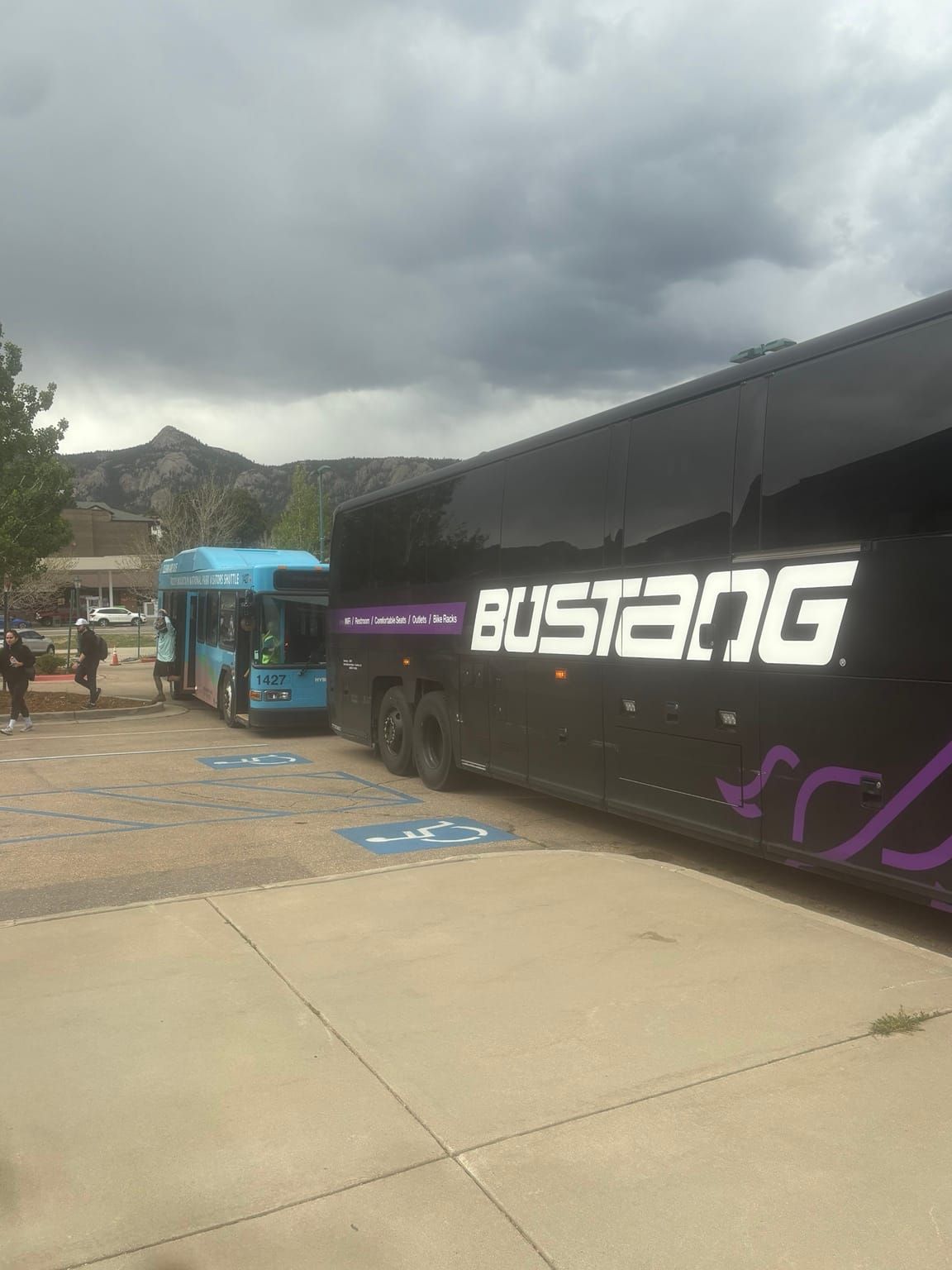
Six Thompson’s Colorado supporters contributed $299.11 to obtain records showing how Colorado could reduce its popular interregional bus service—and to support the reporting required to understand them.
Six readers have contributed $299.11 to Thompson’s Colorado, fully covering the cost of a public-records request that could reveal which Bustang routes, trips and communities are most vulnerable to service cuts.
The first $124.11 is reserved for an invoice from the Colorado Department of Transportation. That payment covers CDOT’s search for records showing the scenarios it has modeled as the agency confronts a significant gap between the cost of operating Bustang’s expanded network and the money available to sustain it.
The remaining $175, before payment-processing fees, will support the work required to turn those records into journalism: reviewing the documents, checking CDOT’s calculations, interviewing experts and affected communities, traveling on Bustang when necessary and maintaining the basic infrastructure Thompson’s Colorado uses to publish.
That distinction matters. Readers did not merely buy a stack of government spreadsheets. They funded the time and tools required to understand what those spreadsheets mean.
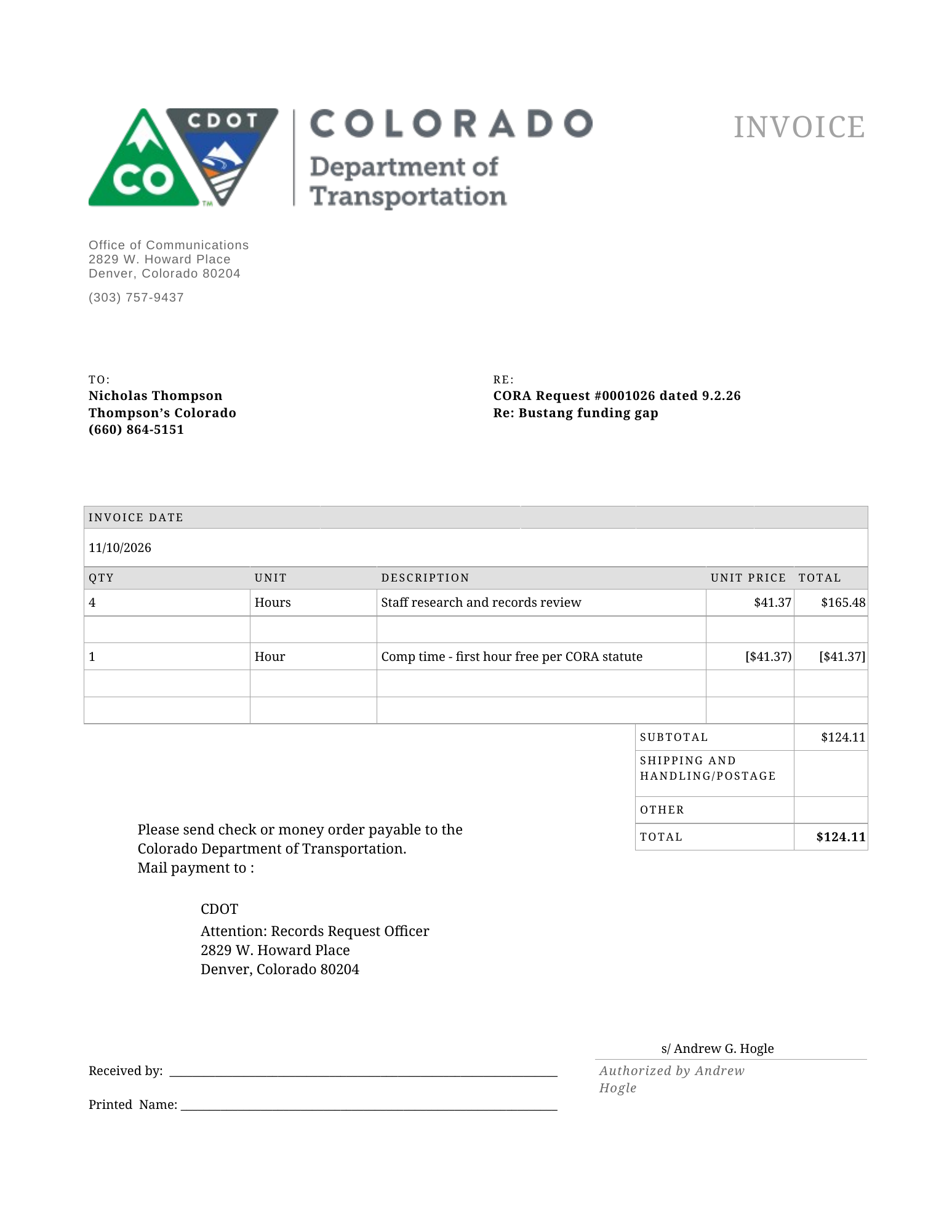
I have now received CDOT’s $124.11 invoice. I will mail the department a money order on Friday, November 13, authorizing it to proceed with the records search.
What we’re trying to learn
Bustang has grown from a relatively limited interregional bus service into an increasingly important statewide transportation network. Its buses connect communities along Interstate 25 and Interstate 70, while related services such as Pegasus, Snowstang and Bustang to Estes provide additional connections.
But expanded service costs money, and the funding that enabled much of that growth was never guaranteed permanently.
CDOT has publicly presented scenarios ranging from maintaining today’s service to returning Bustang roughly to its 2023 level. Another scenario would preserve what the agency calls its “best performing” routes.
Those broad descriptions leave the most important questions unanswered.
Which communities could lose service? Which routes could lose trips? How frequently would the remaining buses operate? How does CDOT define “best performing”—total ridership, passengers per trip, subsidy per passenger, fare revenue, geographic coverage or something else?
Those questions are the reason Thompson’s Colorado filed Colorado Open Records Act request CDOTCORA0001026 on September 2.
The request initially contained 11 categories. They sought service-reduction scenarios, models of a return to 2023 service, estimates of the funding gap, criteria for determining cuts, corridor-level consequences, ridership projections, internal communications, updated financial projections and possible long-term funding solutions.
The request was intentionally broad because I did not know where CDOT kept the relevant analysis—or how far its planning had progressed.
That breadth came with a cost.
From $372.33 to $124.11
CDOT did not provide its first substantive estimate until October 13, weeks after the request was filed and well outside the ordinary timetable established under Colorado’s open-records law.
The agency estimated that employees would need approximately 10 hours to complete the original request. At $41.37 per hour, with the first hour free, the expected charge came to $372.33.
That was not an amount Thompson’s Colorado could afford.
The likeliest cost driver was the request for internal emails and communications. Email searches can require employees to identify custodians, run searches, review individual messages and remove legally protected information.
So I narrowed the request.
I removed the broad communications search and several policy categories that were either secondary to the central story or partially answered through public documents. I retained items 1 through 6 and item 10—the records most likely to show CDOT’s service scenarios, financial models, selection criteria, corridor effects, ridership consequences and updated projections.
CDOT Records Officer Andrew Hogle said the narrowed request would ordinarily require approximately eight staff hours. He then offered to cut that estimate in half because, in his words, the request had “dragged on so long.”
The final invoice, dated November 10, lists four hours of staff research and records review at $41.37 per hour, for $165.48. Colorado law provides the first hour without charge, reducing the amount due to $124.11.
That was a major reduction. It was still money I did not have available without taking it from rent, food, transportation or another immediate need.
So I asked readers.
Thirteen people giving $10
The fundraising appeal was deliberately specific: 13 people contributing approximately $10 each could open the records.
I published CDOT’s quoted price, identified the records-request number and explained the public question those records could answer. I promised to publish the invoice, document how the money was used and recognize contributors who wanted to be named.
The response exceeded anything I expected.
Longmonter Shakeel Dalal contributed exactly $124.11, covering the entire CDOT invoice in a single contribution. Kyle Arehart contributed $25, Maeve Conran contributed $40, Christy Keeling contributed $50, Connie S. Bruce contributed $50 and Valerie Bartell contributed $10.
Altogether, the six contributions totaled $299.11 before processing fees.
That means the records are fully funded, and Thompson’s Colorado has an additional $175 in gross support for the reporting surrounding them.
I have been transparent with readers that I have struggled financially in recent months while trying to keep this publication going. Contributions above the records charge support the reporting time and travel this project requires, along with the infrastructure that allows the work to exist—including Thompson’s Colorado’s $35 monthly Ghost publishing bill.
Independent journalism does not become free because one person is performing the jobs of reporter, editor, publisher, records requester and business manager—all while working a full-time day job.
What happens now
After I mail the money order, CDOT will gather and review the responsive records. Once the files arrive, I will preserve the originals, inventory the production and separate previously public material from genuinely new information.
I will reproduce important calculations and seek outside help where the modeling requires specialized expertise. CDOT will have an opportunity to explain its assumptions and respond to the findings. Transportation researchers, advocates and affected communities will be asked to help evaluate what different service scenarios would mean in practice.
The reporting will also distinguish carefully between a model, a contingency and a decision. A spreadsheet showing that CDOT evaluated eliminating a trip would not necessarily mean the agency has decided to eliminate it.
The records may contain a detailed route-by-route picture. They may show only preliminary scenarios. They could even reveal that CDOT has identified a large funding problem without determining where the consequences would fall.
Whatever they show, Thompson’s Colorado will report that result—not manufacture a bombshell because readers funded the search.
I do not plan to publish another process update between this article and the completed investigation. The next step is to pay the invoice, obtain the records and do the reporting.
The public has done its part. Six people collectively opened a set of government records that one financially strained independent reporter could not afford alone.
Now it is my responsibility to find out what is inside.