Which Longmont RTD Routes Look Most Vulnerable to Budget Cuts?
What routes could be reduced or eliminated in Longmont if RTD moves forward with budget cuts?
Over the past week, I've spent a lot of time covering RTD's budget challenges, proposed fare increases, and potential service reductions.
That got me wondering: if RTD ultimately moves forward with significant cuts, which Longmont routes should riders be paying the closest attention to?
To explore that question, I built a route vulnerability score using RTD performance data, cost-per-boarding figures, and the service reduction scenarios currently being discussed by the agency.
Before diving into the results, it's important to understand that not all Longmont routes serve the same purpose.
A Quick Guide to Longmont's RTD Routes
The 323, 324, 326 and 327 are Longmont's local fixed-route services. Thanks to the city's Ride Free Longmont program, they're free to ride and operate entirely within city limits. These routes connect neighborhoods with downtown, schools, shopping centers, Front Range Community College, medical facilities and other local destinations.
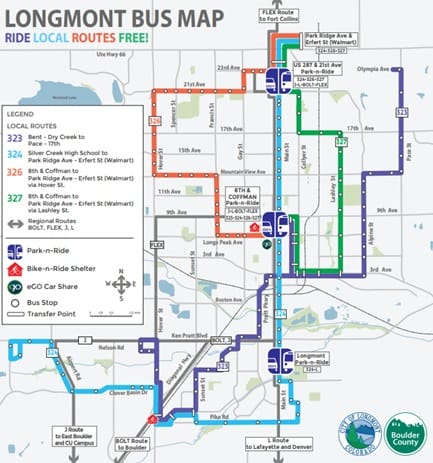
Longmont also operates FlexRide, an on-demand transit service that functions differently than traditional bus routes.
The BOLT serves as Longmont's primary connection to Boulder, carrying riders along the Diagonal Highway corridor through Niwot and into Boulder.
Then there are the regional commuter routes: LD, LX and 287. These routes connect Longmont riders to Denver and the broader RTD system and are often used by commuters traveling longer distances.
With that context in mind, here's how the routes ranked in my analysis. 5 is at most risk for reduction or elimination, while 1 is generally safe.
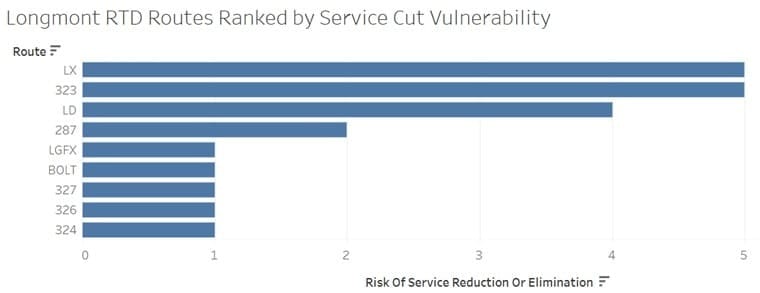
Three routes immediately stood out: LX, 323 and LD.
The LX and 323 received the highest vulnerability scores, while the LD wasn't far behind.
It's important to note that this isn't an official RTD ranking. The vulnerability score is a Thompson's Colorado methodology designed to identify routes that could face increased scrutiny if RTD pursues significant service reductions (the agency is modeling reductions of anywhere from 5-20%).
But when I built a second chart, something interesting happened.
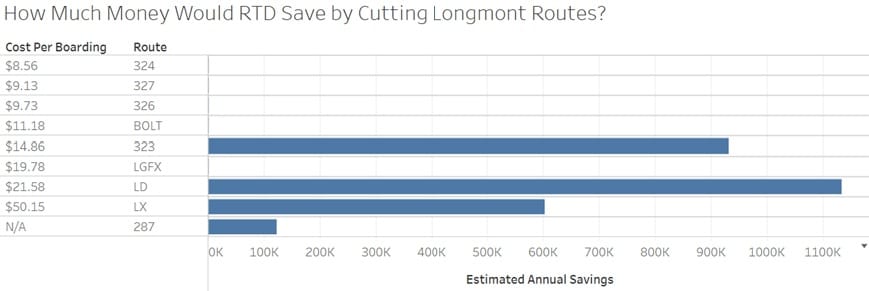
The routes that appear most vulnerable aren't necessarily the routes that save RTD the most money.
According to my analysis, eliminating the LD would generate the largest annual savings — more than $1.1 million per year. The 323 would save roughly $930,000 annually, while the LX would save approximately $600,000.
That's notable because the LX received the highest vulnerability score despite producing significantly less savings than the LD. Under RTD's modeling, LX gets cut in every scenario.
In other words, the route that appears most vulnerable isn't necessarily the route that delivers the biggest financial benefit if eliminated.
That's part of what makes RTD's budget decisions so difficult.
The agency doesn't evaluate routes solely on cost. RTD's service standards also consider ridership, productivity, subsidy per passenger, route performance, transit dependency and broader network needs. RTD specifically notes that routes failing to meet standards are not automatically designated for elimination and that route elimination should be considered a last resort.
To be clear, RTD has not proposed eliminating any of these Longmont routes.
What exists today are service reduction scenarios and ongoing discussions about how the agency closes a substantial budget gap. But if you're a Longmont rider trying to understand where pressure points might emerge in the system, the data suggests three routes are worth watching closely:
LX. 323. LD.
Selfishly, I know if LX and LD go, I can kiss weekday Rockies games and anything on a weeknight in the city goodbye :(