Nearly 210,000 People Have Watched My Videos. It Makes No Damn Sense.
210,000 views and a few months later, I feel like I understand less and less about what makes audiences stick around on the fickle Instagram and Facebook platforms.
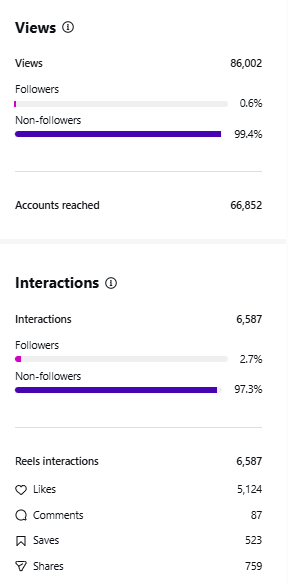
Nearly 210,000 people have watched Thompson's Colorado videos on my @NickThompsonCO account over the last few months—and the more content I make, the less I seem to understand about what people actually want to watch.
Here are 10 things that have genuinely blown my mind about what succeeds, what fails and what the algorithm decides to distribute—followed by five consistent, repeatable habits I'm trying to develop to beat the game.
10 reasons the algorithm makes no damn sense
- A two-minute video about getting to Georgetown without a car approached 100,000 views, while a 45-second video about getting to Estes Park got about 2,000. Estes Park is arguably the easier, more practical and more approachable car-free destination for most people in the Denver area. The Bustang system is straightforward. The trip is replicable. None of that mattered.
- The Georgetown video alone accounts for about 41% of all my video views. It was a piece I almost did not make—and it required roughly one-fifth as much work as some of my more ambitious reporting efforts.
- Longmont train horns doubled the views of both RTD service cuts and fare increases. A hyperlocal nuisance drew more attention than decisions affecting transit riders across the entire Front Range.
- Twenty-one thousand people watched me say there were too many people waiting for the bus after a Rockies game. Meanwhile, I already know that future reporting about the passenger rail service that could actually help solve that problem probably will not receive the same reach.
- The Longmont-to-DIA video reached about 15,000 people and produced only two followers. Thousands of people watched the entire premise play out—and almost none decided they wanted to see what I did next.
- The xeriscaping story performed strongly on Reddit and the Thompson's Colorado website, then underperformed as a reel. It had useful information, strong visuals, a clear financial benefit and an interview with a homeowner who was also a city councilmember. Same reporting. Same story. Completely different audience response.
- Thirteen thousand people watched me take Route 287 to a bike shop. There was no controversy, investigation or major destination. I needed to retrieve my bicycle.
- That ordinary trip to the bike shop outperformed my Ride to End ALZ coverage. Months of training, a meaningful cause, a major physical challenge and a 70-mile event lost to an errand on a bus. The bike shop trip also beat out a video about a 60-mile bike ride with 4,000 feet of elevation change.
- Four thousand people watched me say I was too tired to ride my bicycle very far and took the bus home. Another 4,000 watched me explain why I was happier in a smaller apartment. Relatable personal observations can compete with—and sometimes outperform—actual reporting.
- Four thousand people watched a video about data centers in Boulder County, even though the only immediate news peg was a boring committee meeting that week. Sometimes a complicated policy subject travels. Sometimes a simple service story does not. Every apparent rule is contradicted by another video.
5 ways I'm pushing back against it
- I'm trying to open many stories with a question a 10-year-old would ask—or at least a premise anyone can understand immediately.
Why are we paying someone $3.5 million to study RTD? Why are trains still blowing their horns in Longmont? Why will the city pay you to remove grass? RTD might eliminate the 16th Street FreeRide and the B Line? The goal is to lead with the simple, human stakes before introducing the government language. - I'm producing both short-form videos and full articles instead of letting one platform determine whether a story succeeds.
The xeriscaping article can work even when the reel does not. A transportation reel can reach thousands even when few viewers visit the website. Each format gets another chance to find the audience. - I'm choosing stories based on journalistic value—not just what I think the algorithm might reward.
I'll still report on transit budgets, child care taxes, bilingual hiring goals and government contracts, even when a video about me riding an ordinary bus may reach more people. - I'm building distribution channels I have more control over.
The website, newsletter, search traffic, Reddit audience and direct relationships with readers matter because Instagram and Facebook can expand—or cut off—distribution without explanation. - I'm trying to develop repeatable habits without pretending they guarantee repeatable outcomes.
Ask the obvious question. Establish the stakes immediately. Use a simple premise. Find a human character. Show the journey. Give people a reason to stay until the end. Those habits improve the work, but they do not turn the algorithm into a predictable system.
The algorithm can be a powerful distributor.
It is a terrible editor. It is an even worse judge of what matters.