I Asked to Interview RTD’s $3.5 Million Transit Consultant. Here’s What Happened.
I received a decline to interview the man at the heart of a $3.5 million contract to study Denver transit.

Very Important Note: I am not retracting this piece, because I think that would be cowardly. But it’s not my best work, and in this piece I explain why. I think it’s very important that if you read below, you also read my piece where I point out flaws in my approach here and where I received criticism.
RTD has hired Jarrett Walker + Associates under a contract worth approximately $3.5 million to help redesign the region’s transit network. The recommendations from this study could shape bus frequencies, route design, service priorities and transit investments across the RTD district for years.
The firm is led by Jarrett Walker, a well-known transit planner and academic who has designed system overhauls around the world and authored the influential book Human Transit.
Walker is best known for framing one of transit’s fundamental trade-offs: coverage versus ridership. When an agency faces financial pressure and driver shortages, should it concentrate high-frequency service on dense, high-ridership corridors, or does it have an obligation to provide coverage across an entire region?
In Colorado terms: should RTD put more buses on high-demand corridors like the Flatiron Flyer between Boulder and Denver, or preserve lower-ridership routes like the 228 because they provide basic access to communities with fewer transit options?
That’s the kind of question I wanted to ask Walker.
I’ve heard about Walker’s assignment in every transit meeting I’ve been in over the last three months—from RTD Board meetings to Longmont Transportation Advisory Board meetings, and in private conversations with just about anyone in the Colorado transportation universe.
Transit insiders typically refer to the project as the Comprehensive Operations Analysis, or COA.
RTD communications brands the effort as RTD Connect.
I reached out directly to Walker on July 20 to request an interview. His professional email address is publicly listed on his website.
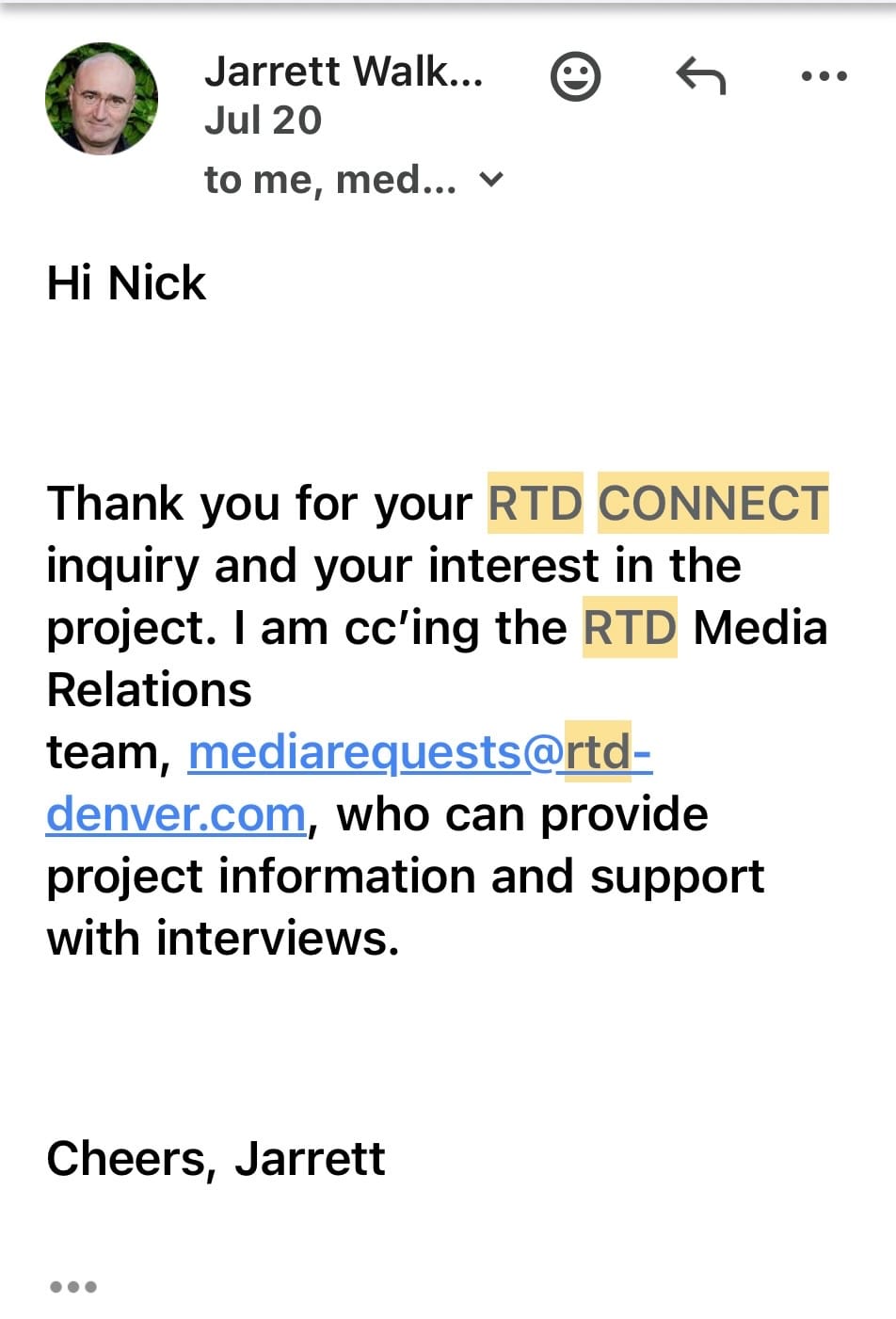
Walker replied within a day and copied RTD Communications.
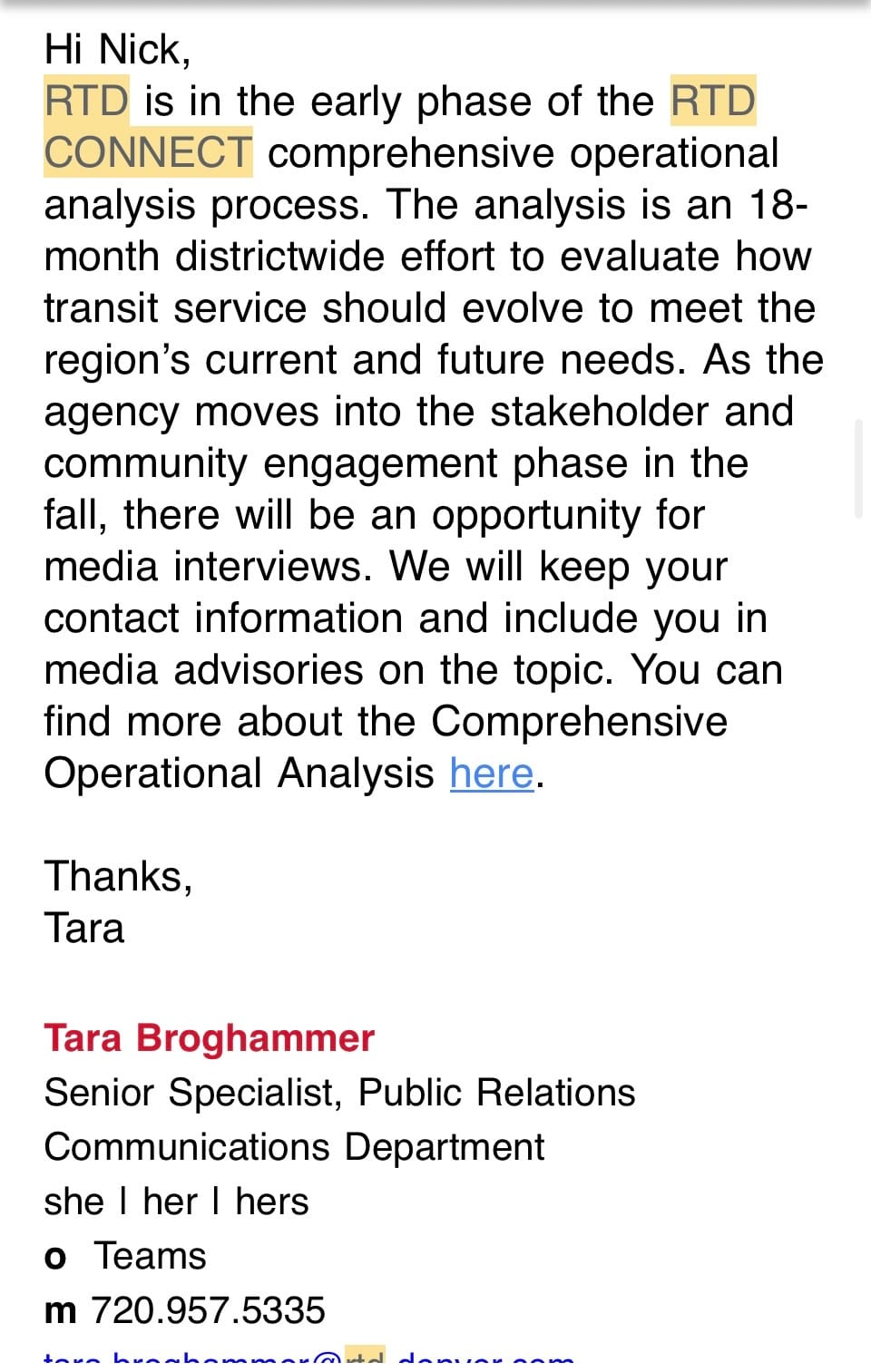
RTD’s media relations team responded with a polite decline:
“As the agency moves into the stakeholder and community engagement phase in the fall, there will be an opportunity for media interviews. We will keep your contact information and include you in media advisories on the topic.”
Then I learned about an Aug. 13 event called the RTD CONNECT Stakeholder Briefing Webinar.
RTD had not mentioned the Aug. 13 briefing in its response to my interview request, and I did not learn about it through a media advisory. I learned about it through a transit advocate Slack channel.
That raised an obvious question: if RTD was already briefing stakeholders in August, what exactly did the agency mean when it told me media access would come during the “stakeholder and community engagement phase in the fall?”
So I went back to RTD.
Just after midnight Friday, I asked the agency:
“I am publishing a story on the RTD CONNECT stakeholder briefing scheduled for August 13 and the media access timeline for Jarrett Walker + Associates. Does RTD have any comment on why the August 13 stakeholder briefing was not noted in response to my July 21 media request regarding stakeholder-phase access?”
I’ve also filed a Colorado Open Records Act request seeking records related to communications surrounding media access and the stakeholder engagement process.
Friday morning, I followed up again.
At 10:20 a.m., I told RTD Media Relations that I planned to publish this story at 5 p.m. Friday.
RTD responded one minute later.
Pauline Haberman, a project manager in RTD Communications, told me the Aug. 13 stakeholder briefing is separate from the public engagement process, which RTD says will begin at the end of September.
RTD also invited me to attend the Aug. 13 briefing.
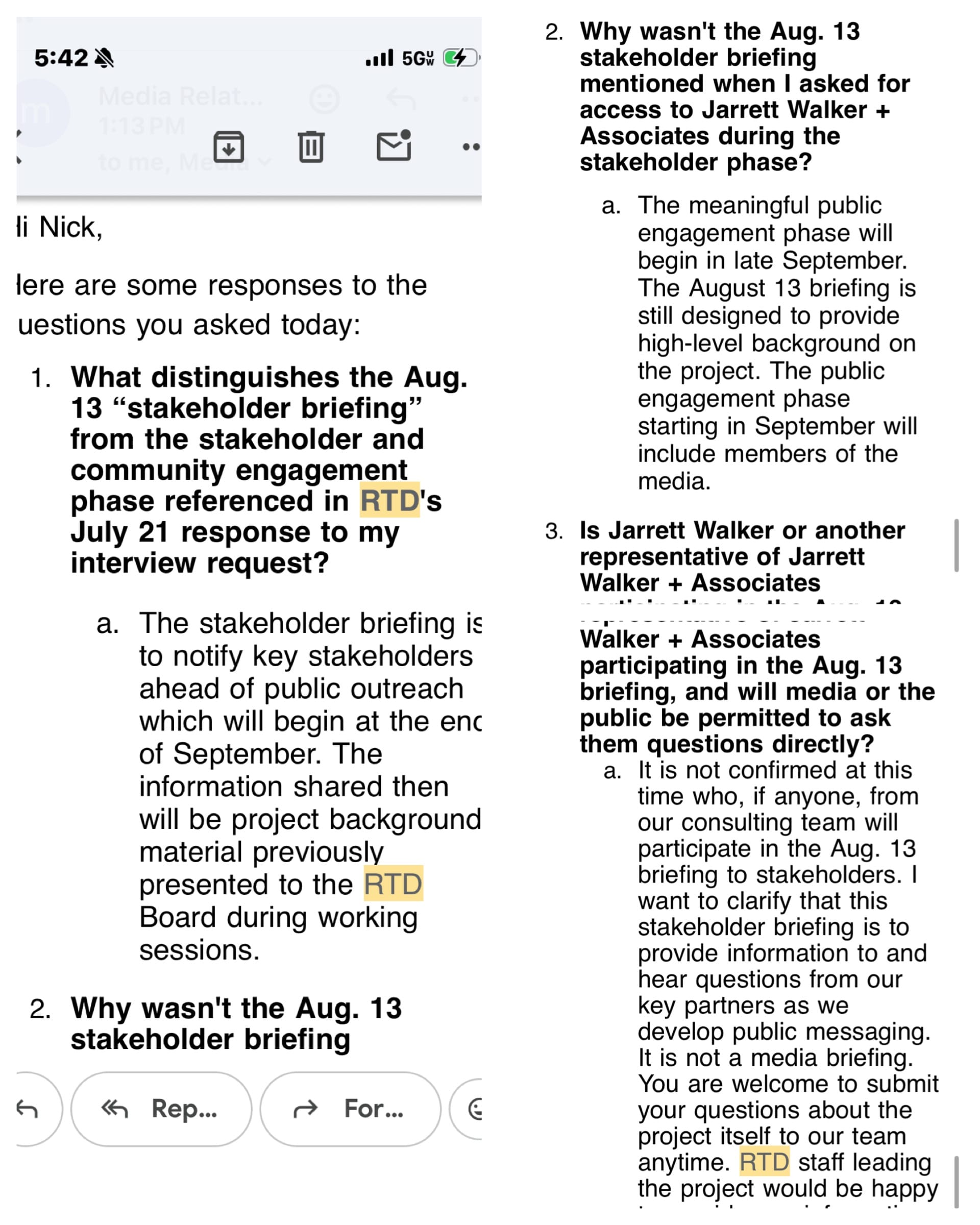
I followed up with three questions: What distinguishes the August briefing from the stakeholder and community engagement phase RTD had previously referenced? Why wasn’t the briefing mentioned when I originally requested access to Walker? And will Walker or another member of his consulting team participate—and, if so, can the media question them?
At 1:13 p.m. Friday, RTD provided answers.
RTD said the Aug. 13 briefing is intended to notify “key stakeholders” before public outreach begins at the end of September. The agency said the briefing will consist of background information previously presented to the RTD Board.
Asked why the briefing wasn’t mentioned when I originally sought access to Walker during the stakeholder phase, RTD said:
“The meaningful public engagement phase will begin in late September. The August 13 briefing is still designed to provide high-level background on the project. The public engagement phase starting in September will include members of the media.”
RTD has not yet confirmed whether Walker—or anyone else from the consulting team—will participate in the Aug. 13 briefing.
The agency also provided perhaps its clearest description yet of what the August event is intended to accomplish:
“This stakeholder briefing is to provide information to and hear questions from our key partners as we develop public messaging. It is not a media briefing.”
RTD said reporters can submit questions about the project at any time and offered to arrange a conversation with RTD staff leading the project.
That clarification makes RTD’s position clearer than it was when I first requested the Walker interview.
The agency distinguishes between an August briefing for selected stakeholders and what it calls the “meaningful public engagement phase” beginning in late September, when members of the media will be included.
But the reason I wanted to talk to Walker in the first place hasn’t changed.
This isn’t simply another consultant contract.
RTD’s Comprehensive Operations Analysis could influence how transit service is distributed across the Denver region for years—from how frequently buses run on heavily traveled corridors to whether lower-ridership routes continue operating at all.
And the study is already being discussed in connection with decisions riders could feel as soon as next year.
In an Aug. 1 Denver Post guest commentary, RTD Director Chris Nicholson wrote that the board had directed management to build its proposed 2027 budget around a $20 million service reduction, with service changes taking effect no later than the May/June 2027 service change.
Nicholson wrote that those eventual changes would be decided through a public process using three criteria: preserving and growing ridership, addressing local transit needs, and applying RTD’s board-adopted service standards “in alignment with the comprehensive operational analysis.”
Nicholson went further, describing the board’s approach as a limited window to reduce costs while developing a “credible long-term plan for transit in the region.”
In other words, the study Walker’s firm is leading isn’t sitting on a shelf waiting for some distant planning exercise. An RTD board member is already publicly identifying the comprehensive operational analysis as one of the guideposts for decisions about approximately $20 million in service reductions next year.
That’s why I continue to believe a 30-minute interview with the consultant leading this work is a reasonable request.
RTD has now invited Thompson’s Colorado to attend the Aug. 13 stakeholder briefing. The agency says the broader public engagement process—including members of the media—will begin in late September.
I’ll be there Aug. 13.
And I’ll keep asking for the Walker interview.