Longmont Broke Ground on 1st & Main. So What Happens Next?
There's a bus station, a parking garage, apartments, BRT, better bike access and eventually a train in the plans. They are not all opening at the same time.
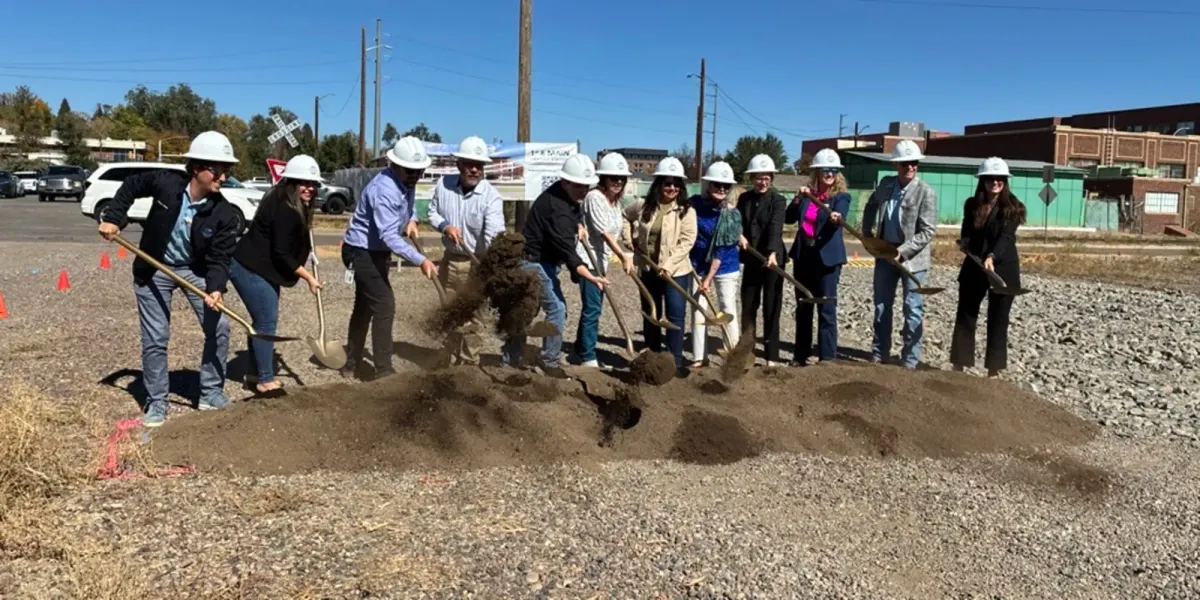
Longmont officials grabbed the ceremonial shovels Friday and broke ground on the 1st & Main Transit Station.
Great.
Now when can I actually use the thing?
That question gets complicated pretty quickly.
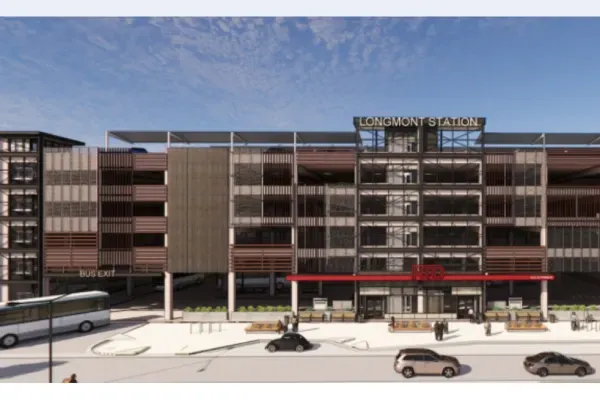
"1st & Main" is being used to describe a bunch of projects that will arrive over several years. There's the actual bus station and parking garage. Coffman Street is being extended. Apartments and commercial space are supposed to wrap around the station. Bus Rapid Transit is coming from Boulder. Front Range Community College is planning a downtown campus nearby.
And eventually there is supposed to be a train.
Longmont has been waiting on that one for a while. RTD launched FasTracks in 2005 with future commuter rail service to Longmont in the plan. Longmont adopted its own master plan for a rail station around First Avenue and Main Street in 2012. More than two decades after FasTracks began, dirt is finally moving.
But don't expect everything you've heard associated with 1st & Main to appear at once.
Who's paying for it
Start with the price tag. The transit center and Coffman Street extension are a roughly $70 million project, according to the city and RTD. The city puts the Coffman extension at about $13 million of that.
The city’s Oct. 9 groundbreaking release puts the Coffman Street extension at $13 million, although its dedicated project page currently lists an estimated cost of $7.6 million.
Three funding sources are public so far. RTD is contributing $16.4 million. The state Department of Local Affairs awarded a $4 million Transit-Oriented Communities Infrastructure grant. And Longmont says it has already spent more than $17.6 million on property and other project costs. Together, that's roughly $38 million.
The city will finance the rest through certificates of participation, a form of lease-financing debt. In September, the Longmont Times-Call reported that the Longmont City Council unanimously authorized up to $38 million in certificates for the parking garage and other capital improvements. Payments are supported by tax-increment revenue from redevelopment, parking fees from the private development and money from the city's Public Improvement Fund and Street Fund.
That tax-increment piece is worth understanding. It only produces revenue when property values or taxable activity in the redevelopment area rise above the established baseline. The city is counting on redevelopment around the station to help generate that growth.
Now, the next four years.
2026: They finally start building it
This is where we are now.
Construction on the bus station and parking garage began in October. The station itself is supposed to be five stories tall. At ground level, there will be 10 bus bays. Above them will be roughly 700 parking spaces. The building will also include bicycle storage. Some of those parking spaces will eventually be leased to the private development planned around the station.
Yes, 700 parking spaces is a lot for a transit project. But 1st & Main isn't being planned as a fancy bus stop where everyone walks up from downtown. It's supposed to be a regional transfer point where people arrive by bus, bike, foot and, eventually, train. Some will also drive there and leave the car behind.
Coffman Street is another big piece. The street is being extended south from First Avenue to Boston Avenue, with the city currently expecting that work to run through summer 2027.
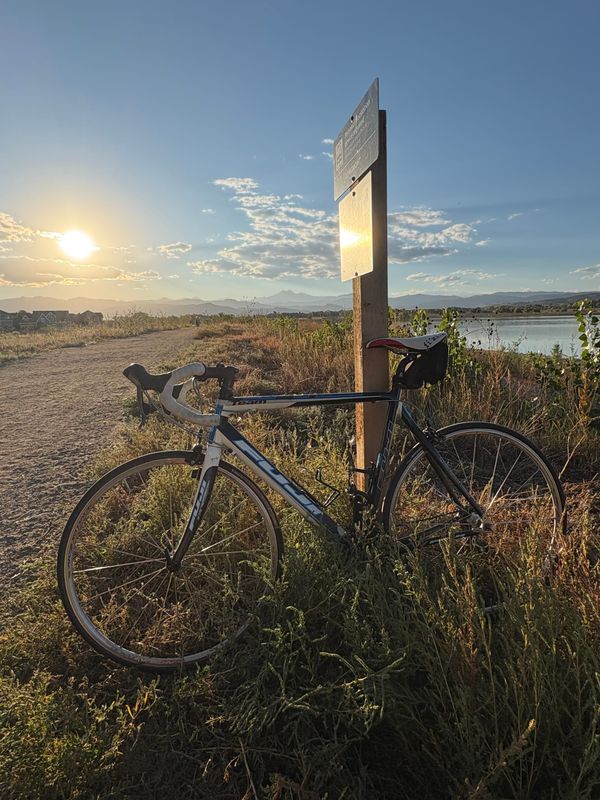
If you use the St. Vrain Greenway now, this part is easier to understand in person than on a rendering. The trail runs just south of downtown, but it doesn't really deliver you into downtown. If I'm coming off the greenway now, the connection is mostly a matter of getting toward Main Street and using the sidewalks and regular street network from there.
It works. It's not exactly elegant.
The plan for Coffman is supposed to give the greenway a much more deliberate connection to 1st & Main and the rest of downtown.
2027: The station starts looking like a station
Longmont's current schedule has the Coffman Street work finishing in summer 2027. The bus station and garage are scheduled to follow in December.
That's when this becomes something you can actually recognize as a transit center instead of a giant construction project at the bottom of Main Street.
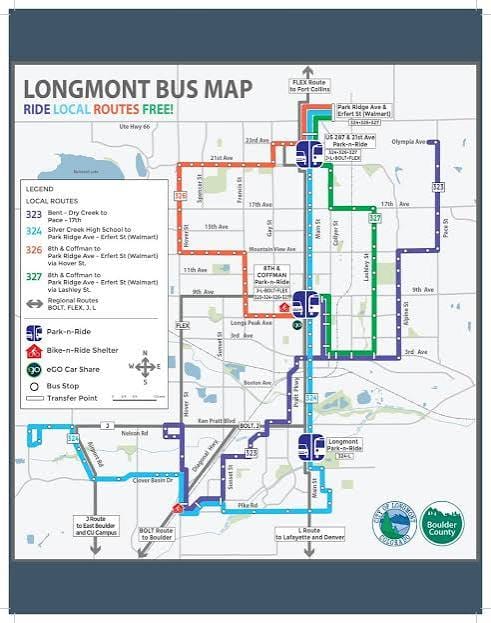
It will serve as a hub for Longmont's current local fixed routes like the 324 instead of 8th and Coffman, which is the main hub downtown today. It will also serve as the terminus for Route AL, the airport route.
Meanwhile, private development is supposed to start going up around it. Longmont says construction on the commercial and apartment portion of 1st & Main is expected to begin in early 2027. Plans call for about 250 homes above commercial space.
2028: The BRT piece comes together
This is when 1st & Main starts functioning as more than a new place to catch the same buses Longmont has today.
Bus Rapid Transit is coming. And BRT deserves a little explanation, because the name makes it sound like CDOT is building some kind of bus-only highway between Boulder and Longmont.
It isn't.
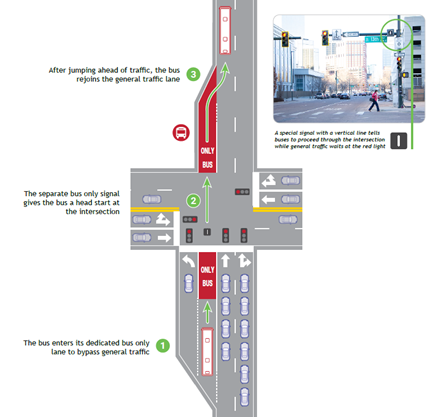
For much of the trip along CO 119, the buses will still travel in regular traffic lanes. The big difference happens at intersections. CDOT is building bus-only queue bypass lanes at Jay Road, 63rd Street, CO 52, Niwot Road and Airport Road.
The idea is pretty simple. Say a bus is approaching a red light and 20 cars are already sitting there. Today, the bus becomes car number 21. With a queue bypass, the bus moves into its own lane near the median, gets a separate signal and goes through the intersection before the rest of traffic. Then it merges back into the regular lanes on the other side.
It doesn't avoid traffic completely. It avoids sitting at the back of the line every time it hits one of those intersections.
CDOT looked at other options, including express lanes, but settled on the queue bypass system as a cheaper way to get much of the same travel-time benefit. The agency says the broader BRT improvements could cut transit travel times through the corridor by nearly half. Depending on where you board in Longmont, the current BOLT trip to Downtown Boulder Station can take roughly 40 minutes to nearly an hour.
The stops themselves are changing too. New BRT stations are being built in the median of CO 119 at 47th Street, 63rd Street, CO 52 and Niwot Road. Some are designed as places where people can leave a car and transfer to the bus.
The 63rd Street station includes a Park-n-Ride and connections to the new Diagonal Bikeway. Niwot Road gets an expanded Park-n-Ride along with bike and pedestrian connections. CO 52 is different. There won't be a Park-n-Ride there. That stop is aimed more at people getting to and from nearby employment areas, including the Boulder Tech Center and IBM area. And not every intersection getting a bus bypass gets a station. Jay Road, for example, gets the transit-priority treatment without becoming one of the major BRT stops.
Once the buses leave the Diagonal, the infrastructure changes again. In Longmont, Coffman Street between First and Ninth avenues is being rebuilt with dedicated BRT lanes.
So this isn't one type of roadway repeated all the way from Boulder to Longmont. There are stretches where buses mix with regular traffic, intersections where they jump the queue, stations built into the highway median and dedicated transit space once they enter parts of the cities.
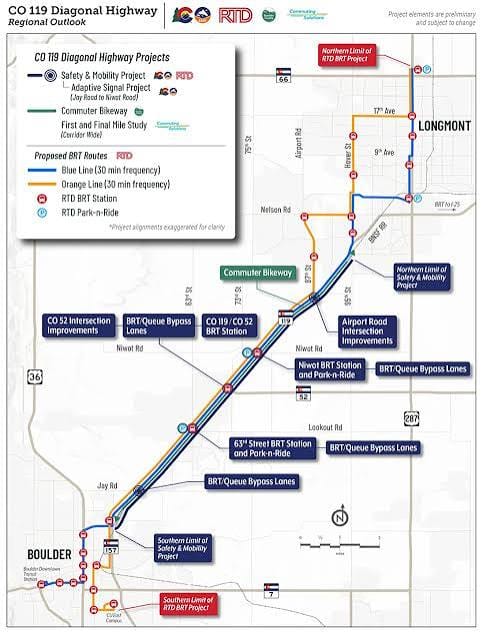
Then there are the routes themselves. RTD calls the service the Diagonal Flyer, and there will be two versions: Blue and Orange.
The Blue route, DF1, is essentially the successor to today's BOLT. It starts at Downtown Boulder Station, heads onto 28th Street and then reaches the new CO 119 stations at 47th Street, 63rd Street, CO 52 and Niwot Road before entering Longmont. This is the route that will serve 1st & Main. Its planned Longmont stops include areas around Hover and Village at the Peaks, Hover and Nelson, the new 1st & Main station, Coffman at Fourth and Eighth, Main at 19th and 21st and Park Ridge/Main toward the north end of town.
The Orange route, DF2, takes a different path. Its southern end is around Baseline and Broadway rather than Downtown Boulder Station. It travels through Boulder Junction before joining the Diagonal. Once it gets to Longmont, it comes in by Airport Road and Nelson, reaches Hover, then works north through the 17th Avenue area before reaching Main Street.
And here's a detail that's easy to miss when everything gets talked about as one giant BRT project: the Orange route does not stop at 1st & Main. Its planned Longmont stops include Airport at Pike and Nelson, Hover at Nelson, Ninth and 17th, 17th at Francis, Main at 19th and 21st and Park Ridge/Main.
So 1st & Main will be a major BRT station. It just won't be the center of every BRT trip through Longmont.
The Blue route is proposed to run at least every 30 minutes on weekdays, with up to 30-minute service on weekends. The Orange is more commuter-focused: CDOT’s project page describes 30-minute service on weekdays during the morning and afternoon peaks only. RTD has said frequency could increase later if ridership and resources allow it.
I'm putting all of this under 2028 even though CDOT's current project page still lists a mid-2027 opening. Longmont now says BRT service is scheduled to begin in early 2028, and RTD's more detailed planning work moved the anticipated full launch to January 2028 so 1st & Main and the other Longmont pieces could be ready.
By 2028, this shouldn't just be the BOLT with a new logo on it. The Blue bus should be able to jump lines of cars at major intersections, stop at purpose-built stations in the middle of the Diagonal, use dedicated transit infrastructure once it reaches Longmont and pull directly into the new 1st & Main station. The Orange will give Longmont another connection to Boulder using a different path through both cities.
And around 1st & Main itself, the private apartment and commercial construction is also scheduled to be wrapping up by the end of 2028.
Still no train.
That's the next year.
2029: Longmont finally gets a train
The Front Range Passenger Rail District says its starter service will begin in 2029 with three daily round trips between Denver Union Station and Fort Collins.
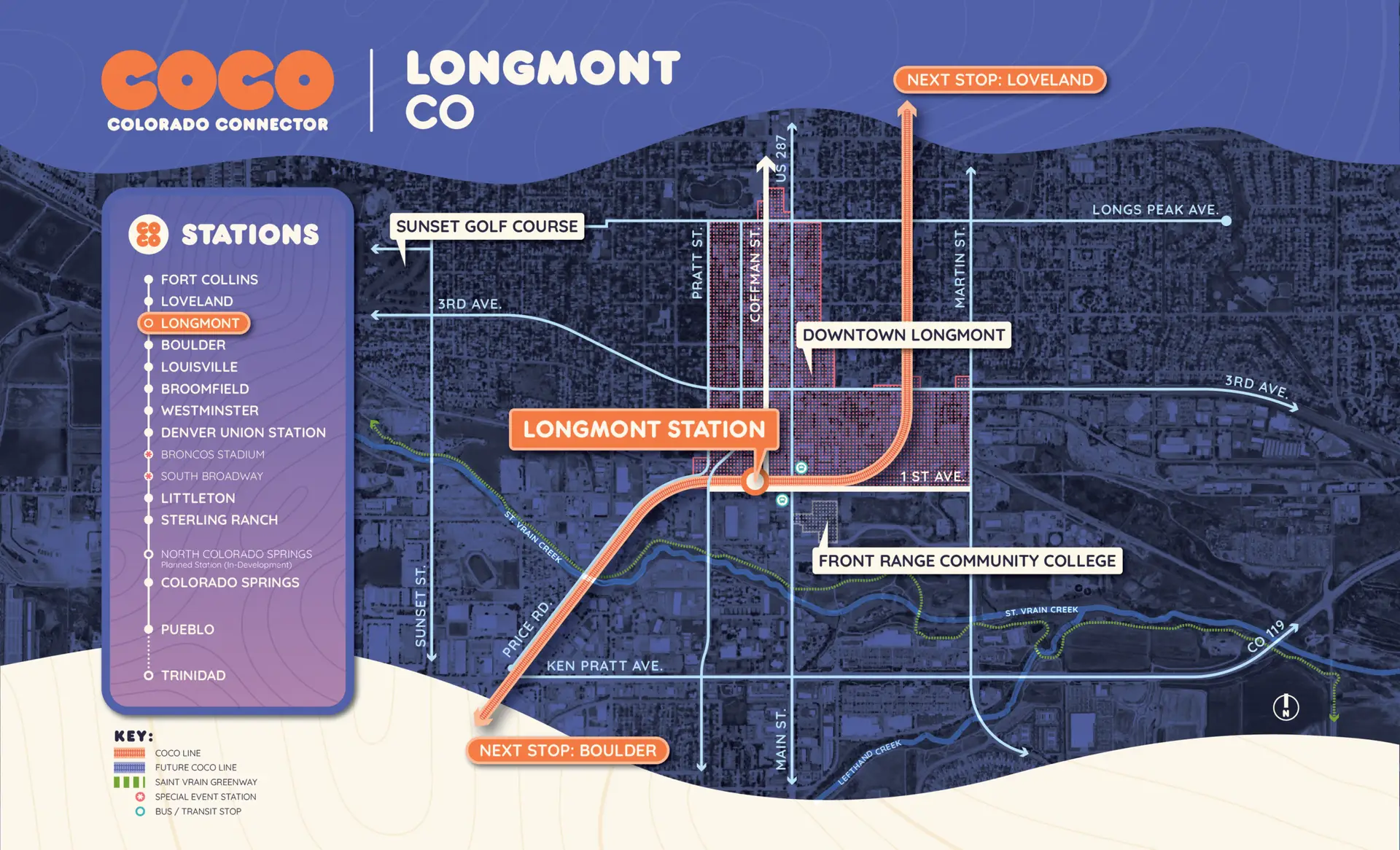
We're not talking about a train rolling into Longmont every 15 minutes. We're not even talking about hourly rail. We're talking about three trips from Denver to Fort Collins and three back each day when service begins.
It's starter service. The district says that initial phase can begin using existing funding commitments. A later phase, currently targeted for 2032, would add more frequent Denver-to-Fort Collins trains and begin service south of Denver toward Colorado Springs and Pueblo. Expanding beyond that starter service depends on voters. Ballot Issue 7A, a one-third-cent sales tax, is on the Nov. 3 ballot in the Front Range Passenger Rail District.
The district also plans to start by using railroad tracks that already exist rather than building a brand-new railroad through Longmont. Colorado has a term sheet with BNSF for passenger access between Denver and Fort Collins, and Amtrak is expected to operate the initial service.
And in Longmont, that train would land right in the middle of everything being built now. That's when the pieces that look disconnected today start meeting in one place.
You could come off the St. Vrain Greenway and have an actual bike connection into downtown instead of improvising your way toward Main Street. You could take the Blue Diagonal Flyer toward Boulder. You could transfer to other Longmont and regional bus service. Or, if the current schedule holds, you could finally board a passenger train to Denver or Fort Collins.
Friday's groundbreaking wasn't the arrival of all of that. It was the beginning.
In 2026, they're digging. By the end of 2027, the station is supposed to be standing. In 2028, BRT should be running through it and the development around the station should look a lot more like the renderings.
Then comes 2029. Three trains a day in each direction.
After more than two decades of Longmont being told a train is coming, I'll believe that part when I can stand at 1st & Main and watch one pull in.