Peaks and Pedagogy: The Story Behind Building a Jazz Scene in Northern Colorado
A Longmont jazz festival this weekend showcases both established acts, and talented young performers trying to gain a foothold in the local scene.
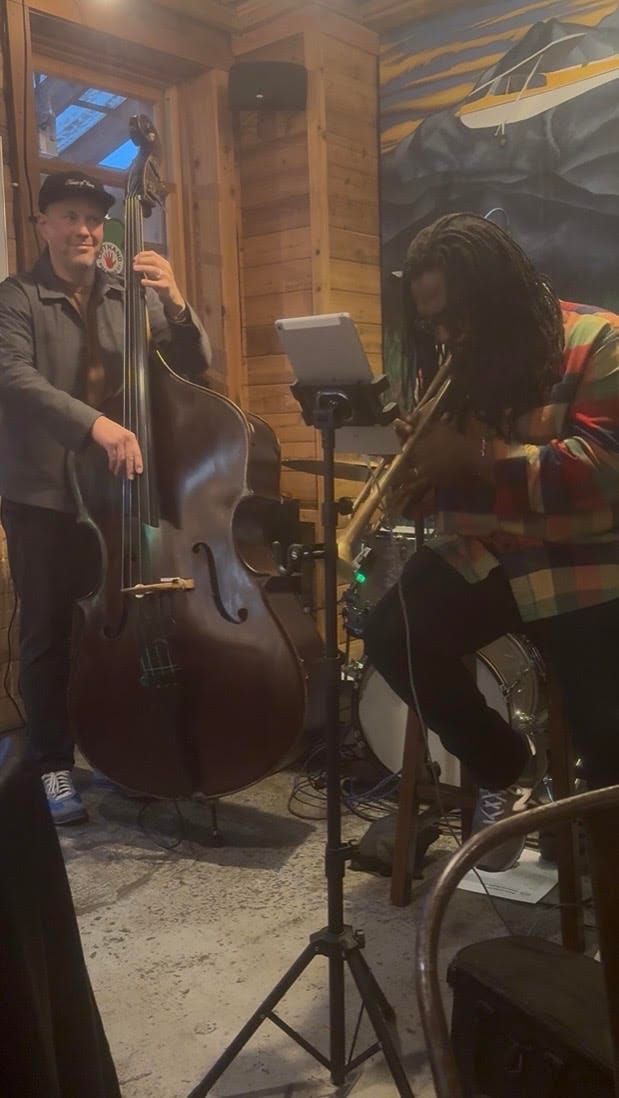
Northern Colorado isn’t New Orleans, Kansas City, New York or L.A., but for Todd VanSelus, it’s been fertile ground for improvisation — both onstage and in his ambitions for Colorado jazz.
VanSelus, 51, grew up in Seattle and moved to the Front Range 20 years ago. He describes jazz as a shared language he’s had a “40-year love affair” with.
“You're improvising and you're listening and you're talking to the people you're playing with using this framework,” VanSelus said.
That helps explain why standards like The Girl From Ipanema, My Funny Valentine and Take the A Train can resonate with audiences across the world, whether they’re played in an East Village club or a microbrewery with a mountain view.
“The brain also loves hearing what it already knows put together in slightly different ways, new ways, creative ways,” VanSelus said.
VanSelus joined his first jazz band in middle school, but didn’t pick up the electric bass until college. His biggest improvisatory experiment came years later, when he switched to upright bass in his mid-30s.
His experiment with upright bass began in the same decade VanSelus met the musicians who would later form the Atom Collective.
The group has played around the Front Range for roughly a decade. Eventually, though, the musicians began thinking beyond their own gigs.
The Atom Collective gave rise to the Atom Jazz Network, a 501 (c) 3 non profit that connects musicians with the educators, mentors, venues and audiences that can turn a collection of individual performances into something resembling a sustainable jazz scene.
“There is a tremendous amount of jazz going on in Colorado,” VanSelus said. “And I don't think — I certainly didn't know — how much.”
Part of the challenge, he said, is convincing people who may not think of themselves as jazz fans to give it a chance.
“They don't know they like jazz or are afraid of it,” VanSelus said. But he said he has found many people have a "jazz curious" tendency somewhere.
The network maintains a calendar of performances around Colorado, but connecting listeners to shows is only part of the mission.
It also tries to make jazz easier for venues to book.
Unlike a touring rock band with a relatively fixed lineup, VanSelus described the local jazz world as a fluid collection of musicians who frequently substitute for one another and play in different combinations. That flexibility is part of the music’s culture, but it can make the scene difficult for a hotel, brewery or restaurant to navigate "who's who."
“We're trying to make it easy for venues to offer really good jazz,” VanSelus said.
At the St Julien Hotel in Boulder, for example, VanSelus said the Atom Jazz Network is given a Thursday slot and a budget, then handles the work of curating the musicians who perform.
VanSelus said the biggest problem is elevating the most deserving artists once a venue relationship starts.
There's a disconnect, VanSelus said, between talent level and getting gigs that can pay a few bills or that do not take too much time away from what pays the bills.
The Atom Collective has regularly played with college and post-college musicians filling in for members of the group.
“In most cases, they're better than we are,” VanSelus said. “I just feel thrilled and honored to play with them.”
Talent, however, doesn't automatically translate into gigs.
“The travesty being that we're getting the gigs a lot of times because we're old and stable, right?” VanSelus said. “And the venue knows that we're reliable and we show up on time and all these things.”
For VanSelus, that question became more urgent after a conversation with saxophonist Alex Loran, a young Colorado musician who wondered whether building a career here would eventually require leaving. “I don't know if I can make this in the Denver area,” VanSelus recalled her saying. “I think I might have to move to LA or New York.”
VanSelus acknowledges that for some musicians, moving to one of the country's established music centers may still be the right path. But the conversation pushed him to ask whether leaving should feel inevitable.
“That really lit our fire to see if we had an opportunity to help her and other players like her to make it in music in Colorado,” VanSelus said, “because I firmly believe the audience is there.”
That ambition is perhaps most visible this weekend at the Atom Jazz Fest at Left Hand Brewing in Longmont.
The Denver Jazz Fest in April imported some of the most well-known acts in jazz, like a Pat Metheny show in Boulder. VanSelus said the festival intentionally showcases musicians already connected to Colorado.
Its performers span generations.
“It spans high school all the way to college, to emerging musicians out of college, to true globally touring professionals,” VanSelus said. “But it's all Colorado.”
The Longmont All-Star Jazz Band gives younger musicians a place on the same festival program as established professional performers, creating the kind of progression the Atom Jazz Network hopes to encourage beyond a single weekend. The All-Star Jazz Band is a collection of area high school players.
The idea for the festival grew partly from something VanSelus had already observed during Atom Collective performances at Left Hand.
People who had come to the brewery without necessarily planning to attend a jazz show would turn their attention toward the band.
“The reaction in the tasting room was both surprising and thrilling,” VanSelus said. “The people turned around and were just loving what we were doing.”
Eventually, Eric Wallace at Left Hand suggested turning that response into a larger festival.
VanSelus was not immediately sold.
“It sounds like way too much work,” he recalled thinking. “That's more than I want to bite off.”
The idea survived.
What began as plans for a one-day event expanded as organizers identified more Colorado musicians they wanted to feature. One day became two, with a Friday kickoff stretching the festival into two and a half days.
For VanSelus, however, putting more musicians onstage also raised the same economic question the network was created to confront: If Colorado wants a thriving jazz scene, who pays the people creating it?
Organizers settled on two rules.
“One, we want to pay the musicians,” VanSelus said. “Nobody's going to play for free. And two, we want it to be free to attend.”
Sponsors, including Left Hand Brewing, KUVO, KGNU and Front Range Community College all hopped on board.
Northern Colorado may never carry the mythology of Bourbon Street, 18th and Vine or a basement jazz club in Greenwich Village. VanSelus isn't trying to manufacture that history. But saxophones and Subarus don’t need to become saxophones and subway cars. That, increasingly, is the point.